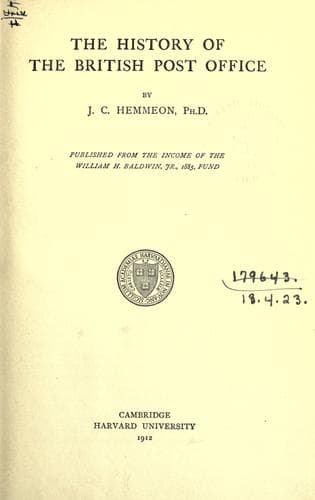
The History of the British Post OfficeHemmeon, Joseph Clarence
History
The History of the British Post Office
Hemmeon, Joseph Clarence
Postal service -- Great Britain -- History
covered four fifths of the gross duty on diamonds and laces, which had
come by the sailing packets during four years, one fifth having been
deducted for postage.[530]
[523] _Cal. S. P. D._, 1650, p. 540.
[524] _Ibid._, 1691-92, pp. 29, 137.
[525] 13 and 14 Chas. II, c. 11.
[526] Goods were not supposed to be carried unless such a licence had
been obtained. Some Jews, coming from Calais on the packet boat, had
brought a few spectacles with them, on the sale of which they said that
their support depended. The spectacles were confiscated (_Cal. T. B. and
P._, 1739-41, p. 61).
[527] _Cal. T. P._, 1708-14, p. 74.
[528] _Cal. T. B. & P._, 1731-34, p. 223.
[529] _Ibid._, 1731-34, p. 242.
[530] _Ibid._, 1731-34, p. 234.
By a section of the act of 1784, letters or packages from abroad
suspected of containing dutiable articles were to be taken by the
postmaster to a Justice of the Peace. He was to take an oath that he
suspected that dutiable goods were contained in the letter or packet. In
the presence of the justice he was then to cut a slit two inches long in
the parcel to permit examination of the contents. If his suspicions
seemed to be confirmed he might slit the cover entirely open and if
anything dutiable were found it must be destroyed. The letter was then
forwarded to the Commissioner of the Customs in order that proceedings
might be taken against those implicated. If nothing was found, the
letter was to be sent to the person to whom it was addressed, under the
magistrate's cover, with no extra charge for postage.[531]
[531] 24 Geo. III, session 2, c. 37.
In one respect, the packet stations in England were conducted on
divergent principles. The supplies for the Harwich packets were advanced
directly by the Government through the Postmaster-General. When the War
of the Austrian Succession broke out, a treasury warrant was issued for
the supply of military stores and eight additional men for each of the
Harwich boats.[532] At Falmouth, the agent supplied all necessaries.
Neither plan was entirely free from objection. When the agent acted as
victualler he naturally tried to make as much as possible out of his
contract, and there were frequent complaints from the men on the
Falmouth boats concerning the quality and quantity of the food. At
Harwich, the drawbacks of the other method, under which the Post Office
did its own victualling, were quite as marked. No bill for provisions
represented what they had actually cost. A percentage was habitually
added to the actual cost and this percentage went into the pockets of
those by whom the goods had been ordered.[533]
[532] _Cal. T. B. & P._, 1742-45, p. 55.
[533] Joyce, pp. 95 f.
Public-domain text, read in full here on John Shaqi.
Reviews
Reviews
No reviews yet
Be the first to share your thoughts on this work.
Elsewhere in the archive
Join the Discussion
Join the discussion
Sign in to leave a comment or review.
Sign InorCreate an account