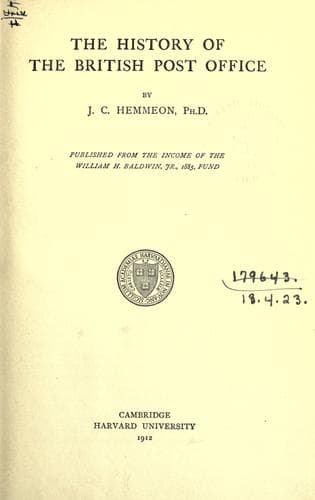
The History of the British Post OfficeHemmeon, Joseph Clarence
History
The History of the British Post Office
Hemmeon, Joseph Clarence
Postal service -- Great Britain -- History
No further reduction in inland postage rates was adopted until the net
revenue of the Post Office had pretty well recovered from the blow
received by the adoption of penny postage.[677] Such reduction was
finally granted in 1865, applying only to letters weighing more than one
ounce each, the increases in weight being graduated by half ounces with
a penny for each additional half ounce instead of 2_d._ for each
additional ounce as before. Corresponding reductions were made at the
same time in the book post and the pattern and sample post, and were
made applicable to correspondence with British North America and the
British possessions in Europe.[678] In 1870, when the impressed
newspaper stamp was finally abolished, the rate on prepaid newspapers
was reduced to a halfpenny each whether sent singly or in packages, but
no package was to be charged higher than the book post rate. Unpaid
newspapers were charged a penny for each two ounces or fraction thereof.
The book post rate was reduced at the same time to a halfpenny for each
two ounces or fraction thereof. The rate for patterns and samples, which
had formerly been 2_d._ for the initial four ounces, was altered to the
existing book post rate with a maximum of twelve ounces only. In 1871
the inland letter rate was fixed at a penny for the initial ounce, a
halfpenny for the next ounce and for each additional two ounces, and the
sample and pattern post was incorporated with the inland letter post. A
separate sample and pattern post was reëstablished in 1887, only to be
incorporated for a second time with the letter post ten years
later.[679] An additional charge for re-directed letters was made when
the re-direction necessitated a change from the original delivery, but
the charge was such only as they would be liable to if prepaid. An
exception was made in the case of letters re-directed to sailors or
soldiers, no additional charge being then made, provided that the rate
was not a foreign one. This privilege was later extended to commissioned
officers and the exemption extended to foreign rates as well.[680] In
1891 all charges for the re-direction of letters were abolished,
followed three years later by a like abolition in the case of all other
postal matter, and in 1900 the charge for notice of removal and
re-direction after the first year was reduced from £1 1_s._ to 1_s._ for
the second and third and 5_s._ for subsequent years.[681]
[677] But in 1861 the registration fee was reduced from 6_d._ to 4_d._
and a double fee charged for compulsory registration (_Rep. P. G._,
1862, pp. 9-10).
[678] _Rep. P. G._, 1866, p. 12.
[679] _Ibid._, 1870, pp. 3-5; 1897, p. 5; 1896, p. 2; 1898, pp. 1-2.
[680] 3 and 4 Vict., c. 96; 10 and 11 Vict., c. 85; 23 and 24 Vict., c.
65.
[681] _Rep. P. G._, 1892, p. 8; 1894, p.2; 1895, p. 4; 1901, p. 4.
Public-domain text, read in full here on John Shaqi.
Reviews
Reviews
No reviews yet
Be the first to share your thoughts on this work.
Elsewhere in the archive
Join the Discussion
Join the discussion
Sign in to leave a comment or review.
Sign InorCreate an account