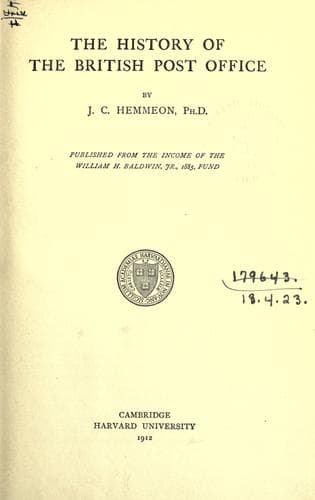
The History of the British Post OfficeHemmeon, Joseph Clarence
History
The History of the British Post Office
Hemmeon, Joseph Clarence
Postal service -- Great Britain -- History
Our knowledge of the financial operations of the Post Office during the
eighteenth century is much more extensive than during the seventeenth,
owing to the reports made by the Post Office officials to the
Parliamentary committees, appointed to enquire into abuses. The reports
are all signed by the Accountant-General or his deputy, and are
therefore as trustworthy as anything which can be obtained. They show
that during the first half of the century, or more explicitly from 1717
to 1754, there was a very small annual increase in gross product, with
an actual decrease in net product, and of course an increase in
expenditure. In round numbers the average yearly gross product for the
years 1725-29 was £179,000, the net product for the same period being
£98,000 and the expenses of management £81,000. For the five years from
1750 to 1754, the average annual gross product was £207,000, net product
£97,000, and expenses £110,000. It is not surprising that there was no
increase worthy of the name in the gross product, for the period under
consideration was a time of stagnation, an intermediate stage just
before the dawn of the industrial revolution. The actual decrease in net
product or, what amounts to the same thing, the increase in expenses of
management, is due largely to the abuse of the franking privilege, the
large amounts received in fees and emoluments, the extraordinary way in
which the packet service was mismanaged, and the losses and increased
expense due to war. Enough has been said about all but the last of these
causes. The Post Office suffered most during war from increased expenses
and direct losses in connection with the sailing packets. The placing of
these upon a war footing involved considerable increased cost. In the
second place, extra boats were used for political purposes in addition
to those regularly employed, and it was customary for the Post Office to
make good to the owners all damages inflicted by the enemy. From 1725 to
1739, the expenses of the Post Office averaged £80,000 or £90,000 a
year. Then came the War of the Austrian Succession, when the expenses
averaged £105,000 per year from 1745 to 1749. The five following years
being a period of peace, the average annual expenses were £110,000,
while the Seven Years' War brought them up to £147,000. It may be
thought that expenses should become normal again when war has ceased,
but it has generally proved to be the rule that although peace brings a
decrease, yet the expenditure does not fall quite so low as before the
war.
Public-domain text, read in full here on John Shaqi.
Reviews
Reviews
No reviews yet
Be the first to share your thoughts on this work.
Elsewhere in the archive
Join the Discussion
Join the discussion
Sign in to leave a comment or review.
Sign InorCreate an account