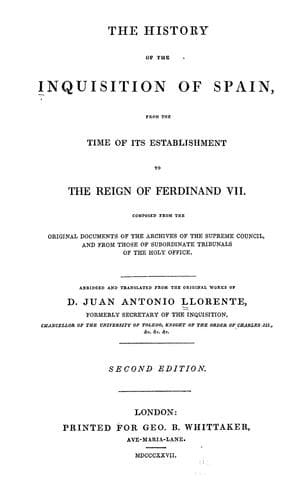
The History of the Inquisition of Spain from the Time of its Establishment to the Reign of Ferdinand VII.Llorente, Juan Antonio
History
The History of the Inquisition of Spain from the Time of its Establishment to the Reign of Ferdinand VII.
Llorente, Juan Antonio
Inquisition -- Spain
On the 22nd of March in the same year the council wrote to the tribunal
of the provinces, that it had remarked, in one of the trials, that
certain writings had not been digested in the places where the facts
mentioned had happened; whence they concluded that these formalities had
not been fulfilled at the proper time, but at the moment when the
proceedings were to begin: the council then recommended them to avoid
these abuses, as contrary to the instructions. But the orders of the
council were not obeyed: the same irregularity was renewed, and produced
another still more dangerous, which during my time had the most serious
consequences. In order to supply what might be omitted in the course of
the trial, the inquisitors adopted the custom of writing each act,
declaration, and deposition, on separate sheets of paper. As in these
tribunals they did not make use of stamped paper, and as the pieces of
the process were not numbered, it often happened that those which they
wished to conceal from the council, the diocesan in ordinary, or other
interested parties, were changed or suppressed. This manoeuvre was
employed by the inquisitors in the affair of the Archbishop of Toledo,
Carranza, and I have myself seen several attestations of the secretary
changed at the request of the inquisitors of Madrid.
The circular of the 11th of July in the same year is more remarkable,
and had more success than the preceding. The inquisitors of the
provinces were directed to refer to the Supreme Council all sentences
pronounced without the unanimity of the inquisitors, the diocesan and
the consulters, even supposing that there was only one dissentient
voice. The inquisitors were afterwards obliged to consult the council on
all the judgments which they passed; and I must confess that this
measure was extremely useful, because, in a difference of opinion, the
decisions of the _supreme_ were much more just than those of the
tribunals of the provinces, from being composed of a greater number of
enlightened judges.
The council displayed the same love of justice in 1536, when it decreed
that those convicted of making use of gold, silver, silk, or precious
stones, should be punished by pecuniary fines, and not by fire, although
they had been prohibited from so doing on pain of being _relaxed_.
Public-domain text, read in full here on John Shaqi.
Reviews
Reviews
No reviews yet
Be the first to share your thoughts on this work.
Elsewhere in the archive
Join the Discussion
Join the discussion
Sign in to leave a comment or review.
Sign InorCreate an account