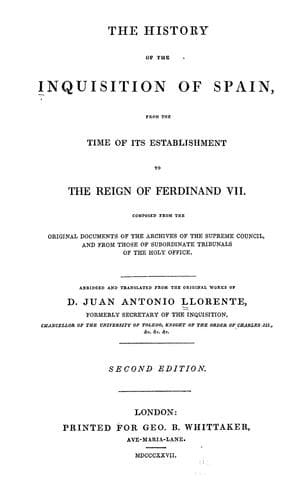
The History of the Inquisition of Spain from the Time of its Establishment to the Reign of Ferdinand VII.Llorente, Juan Antonio
History
The History of the Inquisition of Spain from the Time of its Establishment to the Reign of Ferdinand VII.
Llorente, Juan Antonio
Inquisition -- Spain
Saavedra says, that the court of Lisbon was disturbed at the news of the
arrival of a nuncio in Portugal. This would not be extraordinary, as
neither the Pope nor any other person had written to the court on the
subject, and as the Pope had appointed Don Henry, archbishop of Braga,
the king's brother, inquisitor-general in the preceding year. But if the
arrival of the legate caused so much surprise, it was natural that the
king should write to the Pope, whose answer would have arrived two
months afterwards, and Saavedra would have been detected before the end
of the third month, and thus there would have been no necessity for the
king of Spain to arrest him.
It is not more certain that Saavedra established the Inquisition in
Portugal. The expulsion of the Jews took place in 1492; many of them
retired to Portugal: among them were some that had been baptized, and
John II. consented to receive them into his states, if they would behave
like faithful Christians. King Manuel ordered them to quit the kingdom,
and to leave all their children under the age of fourteen, who were to
be made Christians; they offered to receive baptism, if the king would
promise not to establish the Inquisition for twenty years; the king
granted their request, and also that the names of the witnesses should
be communicated to them, if they were accused of heresy after that
period, besides the power of bequeathing their effects if they were
condemned. In 1507, Manuel confirmed these privileges, prolonging the
first twenty years, and rendering the others perpetual: in 1520, John
renewed the first concession for another twenty years.
Clement VII., being informed that the baptized Jews in Portugal did not
show much attachment to the Christian religion, and that the Protestant
and Lutheran heresies made great progress in the kingdom, appointed
Brother Diego de Silva inquisitor for that country. He attempted to
exercise his functions, but the new Christians claimed their rights,
which were to last for several years; a trial was the result of this
opposition. Clement VII. died, and his successor, Paul III., granted to
the New Christians a privilege which they could not obtain in Portugal;
that they might confide, to persons chosen by themselves, their defence
before the prince of the sense to be given to the dispositions of their
privileges, which had been interpreted to their prejudice. In the same
year, the Pope granted them a pardon for all that had passed.
Public-domain text, read in full here on John Shaqi.
Reviews
Reviews
No reviews yet
Be the first to share your thoughts on this work.
Elsewhere in the archive
Join the Discussion
Join the discussion
Sign in to leave a comment or review.
Sign InorCreate an account