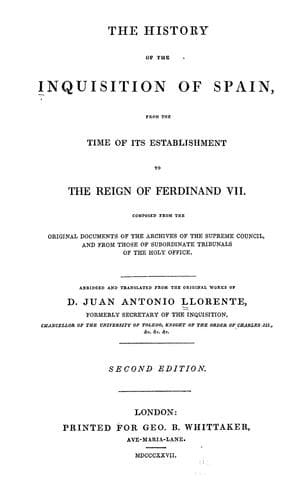
The History of the Inquisition of Spain from the Time of its Establishment to the Reign of Ferdinand VII.Llorente, Juan Antonio
History
The History of the Inquisition of Spain from the Time of its Establishment to the Reign of Ferdinand VII.
Llorente, Juan Antonio
Inquisition -- Spain
Don Ferdinand Valdes was the successor of Cardinal Loaisa in the
archbishopric of Seville, and the office of inquisitor-general. At the
time of his appointment he was bishop of Siguenza, and president of the
royal Council of Castile, after having been successively a member of the
grand College of St. Bartholomew de Salamanca, of the Council of
Administration for the archbishopric of Toledo, for the Cardinal Ximenez
de Cisneros, visitor of the Inquisition of Cuença and of the Royal
Council of Navarre, a member of the Council of State, canon of the
metropolitan church of Santiago de Galicia, counsellor of the Supreme
Inquisition, bishop of Elna, Orensa, Oviedo and Leon, and president of
the Royal Chancery of Valladolid. So many honours could not render him
insensible to the mortification of not being a cardinal like his
predecessors, and of seeing Bartholomew Carranza elevated to the see of
Toledo. This was the true cause of his cruel persecution of Carranza.
The Pope approved the nomination of Valdés in January, 1547, and he took
possession of his office in the following month. Valdés displayed an
almost sanguinary disposition during his administration. It led him to
demand from the Pope the power of condemning Lutherans to be burnt, even
though they had not relapsed, and had desired to be reconciled. I shall
here make known the most illustrious of the victims sacrificed before
the abdication of Charles V., as it is necessary to make a separate
article for the events of that nature under the reign of Philip II.
Among the condemned persons who appeared in the _auto-da-fé_ of Seville
in 1552, was Juan Gil, a native of Olvera, in Aragon, and a canon in the
metropolitan church of that city; he is better known by the name of
Doctor _Egidius_. He was first condemned, as violently suspected, to
abjure the Lutheran heresy, and to be subjected to a penance; but four
years after his death, in 1556, he was condemned, and, as having
relapsed, his body was disinterred, and burnt with his effigy; his
memory was declared infamous, and his property confiscated, for having
died as a Lutheran. Raymond Gonzales de Montes was his companion in
prison, but succeeded in escaping, and was burnt in effigy. In a work
written on the Spanish Inquisition, he has introduced several
particulars relating to the life of _Juan Gil_. He informs us that
Egidius studied theology at Alcala de Henares, and there obtained the
title of Doctor. He acquired so great a reputation, that he was compared
to Peter Lombard, to St. Thomas d'Aquinas, to John Scott, and other
theologians of the greatest merit. His talents induced the chapter of
Seville to offer him unanimously the office of preacher to the
cathedral. Egidius had very little talent for preaching, and the canons
soon repented of having appointed him.
Public-domain text, read in full here on John Shaqi.
Reviews
Reviews
No reviews yet
Be the first to share your thoughts on this work.
Elsewhere in the archive
Join the Discussion
Join the discussion
Sign in to leave a comment or review.
Sign InorCreate an account