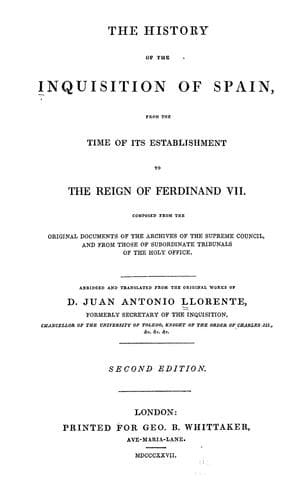
The History of the Inquisition of Spain from the Time of its Establishment to the Reign of Ferdinand VII.Llorente, Juan Antonio
History
The History of the Inquisition of Spain from the Time of its Establishment to the Reign of Ferdinand VII.
Llorente, Juan Antonio
Inquisition -- Spain
Rodrigo de Valero told Egidius that the books from which he derived his
knowledge were worth nothing, and that his preaching would never be
admired, if he did not study the Bible. Egidius took his advice, and in
time acquired a style of preaching extremely agreeable to the people,
but his success raised him many enemies.
The emperor gave him the Bishopric of Tortosa in 1550, which increasing
the envy and hatred of his enemies, they denounced him to the
Inquisition of Seville as a Lutheran heretic, for some propositions
which he had advanced in his sermons, and which they separated from the
other parts, to give them a different sense from what they would
otherwise have had; they took advantage of the favour he showed to
Rodrigo Valero in 1540 during his trial, and of some other
circumstances, to injure him.
Egidius was taken to the secret prisons of the holy office in 1550: he
made use of this opportunity to compose his apology, which rendered the
storm his enemies had raised still more violent. His simplicity had made
him, in his apology, establish as certain principles, some propositions
which the scholastic theologians looked upon as erroneous, and tending
to heresy. The conduct and morals of Egidius were so pure, that the
emperor wrote in his favour, the chapter of Seville followed his
example, and (what is still more remarkable) the licentiate, Correa,
Dean of the inquisitors, was touched by his innocence, and undertook to
defend him against his colleague, Pedro Diaz, who bore the greatest
hatred to the accused. This circumstance was particularly mortifying to
Egidius, as his enemy formerly held the same opinions, and had likewise
studied in the school of Rodrigo Valero.
The interest which Egidius had inspired induced the inquisitors to
accede to his proposal of a discussion between him and some learned
theologians. Brother Garcia de Arias, of the convent of St. Isidore of
Seville, was chosen; but his opinion was not deemed sufficient, and Juan
Gil demanded the Dominican friar, Dominic Soto, should be summoned to
the conference. This incidence retarded the trial, but Soto at last
arrived at Seville.
According to Gonzales de Montes, this theologian held the same opinions
as Egidius; but to prevent the suspicions which might arise from this
circumstance, he persuaded Egidius to draw up a sort of confession of
faith. They agreed that both should write their opinions, and only
communicate them to each other in public. This author states that these
confessions of faith were compared, and found to accord perfectly.
Public-domain text, read in full here on John Shaqi.
Reviews
Reviews
No reviews yet
Be the first to share your thoughts on this work.
Elsewhere in the archive
Join the Discussion
Join the discussion
Sign in to leave a comment or review.
Sign InorCreate an account