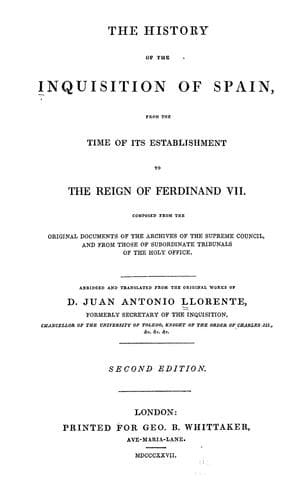
The History of the Inquisition of Spain from the Time of its Establishment to the Reign of Ferdinand VII.Llorente, Juan Antonio
History
The History of the Inquisition of Spain from the Time of its Establishment to the Reign of Ferdinand VII.
Llorente, Juan Antonio
Inquisition -- Spain
Felix, Bishop of Urgel, in Spain, had embraced the erroneous opinion
that Jesus Christ was the Son of God only by adoption. He returned to
the faith of the church, but relapsed some time after into the same
error, although he had abjured, before the Council of Ratisbonne, in
792, and before Pope Adrian, at Rome. The conduct of Felix was very
reprehensible, yet Leo III. would not excommunicate him in a simple
manner, but only pronounced, the anathema against him, in case he
refused to abjure a second time. Felix afterwards abjured, and suffered
no punishment but deprivation of his dignity.
The Emperor Michel, in 811, renewed all the laws which condemned the
Manichean heretics to death. The patriarch Nicephorus represented to him
that it was better to convert them by gentle means; but the spirit of
the church at that time was so far from moderation, that the Abbot
Theophanes, celebrated for his piety, does not hesitate to speak of
Nicephorus and the other counsellors of the prince, as ignorant and ill
advised; and adds, that the maxims of Holy Writ warrant the custom of
burning heretics, because they can never be brought to repent.
Theodore Critinus, chief of the Iconoclastes, was called before the
seventh council general, assembled at Constantinople in 869. He was
convicted of entertaining opinions contrary to the doctrines of the
church: he abjured his heresy, with several of his sect, and was
reconciled without being subjected to any penance. The Emperor Basil,
who assisted at the council, honoured him with a kiss of peace. We may
conclude from this, that if the conduct of the church had always been
equally lenient, heresy would not have been so frequent among the
Christians.
In 1022, certain heretics, who appeared to profess the doctrines of the
Manicheans, were discovered in Orleans, and several other towns; among
them was Stephen, confessor to Queen Constance, wife of Robert. That
prince assembled a council at Orleans: Stephen was summoned to appear
before it, and attempts were made, but in vain, to bring him back to the
true faith. The bishops resolved to punish these heretics, and those who
were ecclesiastics were degraded and excommunicated with the others. The
king immediately afterwards condemned them to be burnt. Several, when
they felt the flames, exclaimed that they were willing to submit to the
church; but it was too late, all hearts were closed against them. These
examples show the difference which was made between the Manichean and
other heresies.
Public-domain text, read in full here on John Shaqi.
Reviews
Reviews
No reviews yet
Be the first to share your thoughts on this work.
Join the Discussion
Join the discussion
Sign in to leave a comment or review.
Sign InorCreate an account