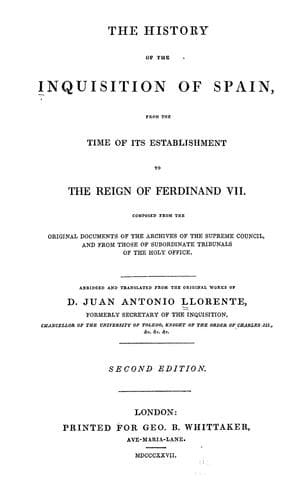
The History of the Inquisition of Spain from the Time of its Establishment to the Reign of Ferdinand VII.Llorente, Juan Antonio
History
The History of the Inquisition of Spain from the Time of its Establishment to the Reign of Ferdinand VII.
Llorente, Juan Antonio
Inquisition -- Spain
In the fourth, fifth, sixth, and seventh centuries, the ecclesiastics
obtained many privileges from the kings and emperors, and the judicial
power became, in some cases, a right of the episcopacy. These
acquisitions, and the universal ignorance which followed the irruption
of the barbarians, were the causes of the influence which the pontiffs
of Rome acquired over the Christian people, who were persuaded that the
authority of the pope should be without bounds, and that he had supreme
power both in ecclesiastical and temporal affairs.
In 726, when the Romans deposed their last duke, Basil, Pope Gregory
II. usurped the civil government of Rome, and had recourse to the
protection of Charles Martel, mayor of the palace, against the King of
Lombardy, who aspired to the command in that capital. His successor,
Gregory III., offered the dignity of patrician to Charles Martel, as if
he had the right of disposing of it. Zachary, who was elected pope, in
741, acted as the temporal sovereign of Rome, and permitted Pepin, son
of Charles Martel, to take the title of King of France, after having
deposed Childeric III., who was the legitimate sovereign. Pepin was
crowned in France by Stephen II., who became pope in 752.
At last, Leo III. crowned Charlemagne emperor of the west, on Christmas
day, in the year 800. In this ceremony, which took place at Rome,
Charlemagne was proclaimed the first emperor of the restoration.
The popes employed the great influence they had gained over general
opinion, to extend and preserve their dominion. Pepin and Charlemagne
did not foresee how fatal their example would prove to their successors,
when they solicited Stephen II. to release the French from their oath of
fidelity to Childeric III. When the doctrine, that a pope possessed the
power of releasing subjects from their oath of fidelity, was once
established, it became necessary that kings should endeavour to
conciliate the popes. Succeeding events show that this doctrine was
favourable to the rise of the Inquisition.
The idea that excommunication produced all the effects attached to
infamy, not only to the Christian on whom it fell, but to all who held
any communion with him, was another cause of the great influence of the
popes, and the progress of the Inquisition. The barbarians had preserved
the doctrine of the Druids, which forbade a Gaul to assist one whom the
priests had declared impious and abhorred of the gods, on pain of being
deemed guilty towards the gods, and unworthy of the society of men. The
priests, finding this opinion established, did not combat it, because
it added force to the anathemas of the church. Fortunately the popes of
the middle ages had not yet thought of commissioning men to ascertain if
Christians were orthodox, and the ancient discipline of the church was
still pursued towards heretics.
Public-domain text, read in full here on John Shaqi.
Reviews
Reviews
No reviews yet
Be the first to share your thoughts on this work.
Join the Discussion
Join the discussion
Sign in to leave a comment or review.
Sign InorCreate an account