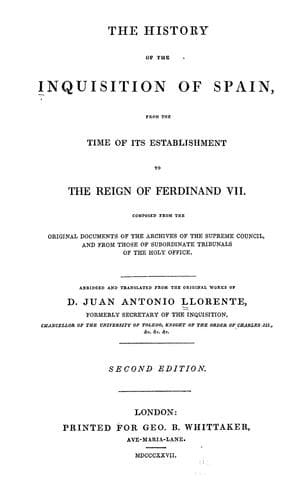
The History of the Inquisition of Spain from the Time of its Establishment to the Reign of Ferdinand VII.Llorente, Juan Antonio
History
The History of the Inquisition of Spain from the Time of its Establishment to the Reign of Ferdinand VII.
Llorente, Juan Antonio
Inquisition -- Spain
Donna Eleonora de Vibero (the wife of Pedro Cazalla, who held an office
in the Treasury), daughter of Juan de Vibero, who had a similar
employment, and Constance Ortiz, was proprietress of a chapel in the
Benedictine convent of Valladolid. She had been interred without any
doubt of her orthodoxy; but she was accused of Lutheranism by the fiscal
of the Inquisition, though he said she had concealed her opinions, by
receiving the sacraments and the eucharist at her death. He supported
his accusation by the testimony of several witnesses who had been
tortured or threatened, the result of which was that the house of
Eleonora de Vibero had been used as a temple by the Lutherans. Her
memory and her posterity were condemned to infamy, her property
confiscated, her body disinterred and burnt with her effigy, and her
house razed to the ground, and prohibited from being rebuilt; a monument
with an inscription relating to this event was placed on the spot. I
have seen the column and the inscription; I have heard that it was
destroyed in 1809.
The other principal persons who perished in this _auto-da-fé_ were,
Doctor Augustin Cazalla, priest and canon of Salamanca, almoner and
preacher to the king and emperor; he was the son of Pedro Cazalla and
Eleonora de Vibero, and descended from the Jews both by his father and
mother. He was accused of professing the Lutheran heresy; of having
dogmatized in the Lutheran conventicle of Valladolid, and corresponded
with the heretics of Seville. Cazalla denied the facts imputed to him in
several declarations on oath, and in others which he presented when the
_publication of the proofs_ took place. The torture was decreed:
Cazalla, on the 4th of March, was conducted to the dungeon where it was
to be inflicted, but it did not take place, as the prisoner promised to
make a confession. He gave it in writing, and ratified it on the 16th,
acknowledging that he was a Lutheran, but denied having taught the
doctrine. He explained the motives which had prevented him from making
this declaration before; and promised to be a good catholic for the
future, if reconciliation was granted to him; but the inquisitors did
not think proper to spare him the capital punishment, as the witnesses
affirmed that he had dogmatized. Cazalla, however, continued to give
every possible proof of conversion until his execution: when he saw that
death was inevitable, he began to preach to his companions in
misfortune. Two days before his death, he related some particulars of
his life. He was born in 1510: at the age of seventeen he had
Bartholomew Carranza de Miranda for his confessor, in the college of St.
Gregory at Valladolid; he continued his studies at Alcala de Henares,
where he remained till 1536. In 1545 Charles V. made him his preacher;
in the following year he accompanied that prince to Germany, and stayed
there till 1552, preaching against the Lutherans; he returned in that
Public-domain text, read in full here on John Shaqi.
Reviews
Reviews
No reviews yet
Be the first to share your thoughts on this work.
Elsewhere in the archive
Join the Discussion
Join the discussion
Sign in to leave a comment or review.
Sign InorCreate an account