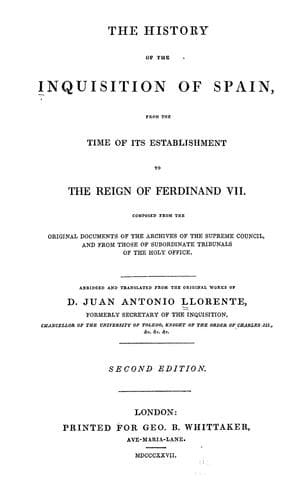
The History of the Inquisition of Spain from the Time of its Establishment to the Reign of Ferdinand VII.Llorente, Juan Antonio
History
The History of the Inquisition of Spain from the Time of its Establishment to the Reign of Ferdinand VII.
Llorente, Juan Antonio
Inquisition -- Spain
The famous French monk Gerbert being elected pope in 999, under the name
of Sylvester II., addressed a letter to all Christians, in which he
supposes the Church of Jerusalem speaking from its ruins, and calling
upon them to take up arms and fight boldly to deliver it from
oppression. Gregory VII. also undertook, in 1074, to form a crusade
against the Turks, in favour of Michael, emperor of the East; but as he
died before he could put his plan into execution, his successor, Urban
II., caused it to be proclaimed in the Council of Clermont, in the year
1095. The efforts of the pope had an incredible success; a numerous army
left Europe soon after, which first took the city of Antioch, and
afterwards Jerusalem in 1099. The injustice of this war, and the other
expeditions of the same kind which succeeded it, would have disgusted
all Europe, if the people had not been prepossessed with the absurd
idea, that it was meritorious to make war for the exaltation and glory
of Christianity: the consequences of a system so fatal to temporal power
were felt in France at the time of the Patarians, Catharians, and other
sects of Manès. Alexander III., having sent Peter, Bishop of Meaux, to
Count Raymond V. of Toulouse, that legate made him and all his nobles
take an oath that they would not favour the heretics who had taken up
arms in defence of their party; and in the Council of Lateran, the
following year, the fathers declared that though the church did not
approve of sanguinary measures, yet she would not refuse the assistance
offered by Christian princes: in consequence, Alexander not only
excommunicated the heretics and their adherents, but promised all those
who should die in the war against them absolution and salvation, and for
the present granted indulgences for two years to all who should take up
arms.
In 1181, Cardinal Henry, Bishop of Alva, was sent into France to pursue
the war against the Albigenses; but this expedition did not entirely
destroy that party, and a new council was held, in whose decrees
Cardinal Fleury supposes he has discovered the origin of the
Inquisition. He was not mistaken in this opinion, but it was not at that
time actually instituted, since the bishops alone, as they had always
been, were commissioned to preserve the faith. The council recommended
that the bishops, or their archdeacons, should visit the dioceses once
or twice a year, and that they should cause the inhabitants to take an
oath that they would denounce all heretics, or persons who held
meetings, to the bishop or archdeacon. The council also decreed that
counts, barons, and other nobles should take an oath to discover
heretics and punish them, on pain of excommunication and deprivation of
their estates and employments.
Public-domain text, read in full here on John Shaqi.
Reviews
Reviews
No reviews yet
Be the first to share your thoughts on this work.
Join the Discussion
Join the discussion
Sign in to leave a comment or review.
Sign InorCreate an account