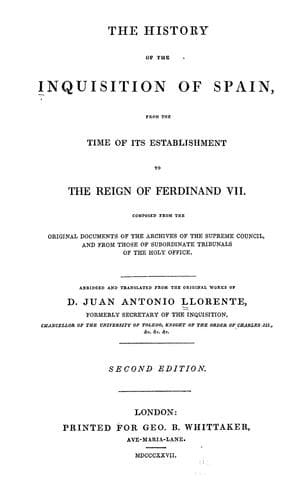
The History of the Inquisition of Spain from the Time of its Establishment to the Reign of Ferdinand VII.Llorente, Juan Antonio
History
The History of the Inquisition of Spain from the Time of its Establishment to the Reign of Ferdinand VII.
Llorente, Juan Antonio
Inquisition -- Spain
In 1194, Cardinal Gregory St. Angelo instigated Alphonso II., King of
Aragon, to publish an edict banishing heretics of all sects
indiscriminately from his states; and Peter II., son of Alphonso,
published another in 1197, with nearly the same injunctions, which
proves that the former edict had little effect.
CHAPTER II.
ESTABLISHMENT OF A GENERAL INQUISITION AGAINST HERETICS IN THE
THIRTEENTH CENTURY.
In 1203, Pope Innocent III. commissioned Peter de Castelnau and Ralph,
two monks of the order of Cistercians, in the monastery of Fontfroide,
in Narbonnese Gaul, to preach against the Albigenses. Their exhortations
were not in vain, and the success of their mission was a favourable
introduction to a plan which Pope Innocent had formed of instituting
inquisitors independent of the bishops, with the privilege of
prosecuting heretics, as delegates of the holy see.
On the 4th of June, in the seventh year of his pontificate, he named the
abbot of the Cistercians, with Peter and Ralph, apostolical legates. He
gave them full powers to prosecute all heretics; and to facilitate the
execution of the orders of the holy see, they were to engage in the name
of the pope, Philip II., King of France, his son, and all his nobles, to
pursue the heretics, and to promise them full indulgences as a
recompense for their zeal. The pope invested these monks with the
necessary powers to enable them to destroy or establish whatever they
might judge to be favourable to their design, in the ecclesiastical
provinces of Aix, Arles, Narbonne, and other bishoprics where heretics
might be found, only recommending that they should apply to the holy see
in all difficult cases; at the same time he wrote to Philip, requesting
him to assist his commissioners, and even, if it was necessary, to send
the presumptive heir to his throne with an army against the heretics.
The legates encountered many difficulties, because their mission was
displeasing to the bishops. The King of France took no part in the
affair, but the Counts of Toulouse, Foix, Beziers, Cominges, and
Carcassone, and the other nobles of these provinces, seeing that the
Albigenses had singularly increased, and persuaded that a very small
number would be converted, refused to banish them from their states, as
it would lessen the population, and, consequently, be against their
interests: an additional motive for this refusal was, that these
heretics were all peaceful and submissive subjects.
Public-domain text, read in full here on John Shaqi.
Reviews
Reviews
No reviews yet
Be the first to share your thoughts on this work.
Join the Discussion
Join the discussion
Sign in to leave a comment or review.
Sign InorCreate an account