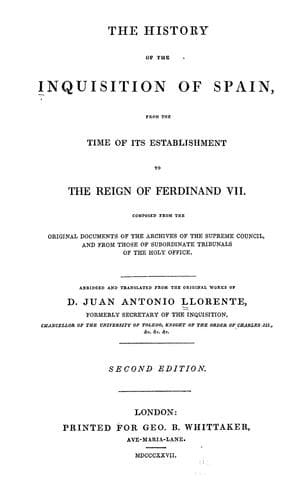
The History of the Inquisition of Spain from the Time of its Establishment to the Reign of Ferdinand VII.Llorente, Juan Antonio
History
The History of the Inquisition of Spain from the Time of its Establishment to the Reign of Ferdinand VII.
Llorente, Juan Antonio
Inquisition -- Spain
Although the Inquisition of Toledo celebrated as many _autos-da-fé_ as
the other tribunals, I do not find any persons of distinction among the
victims, until the _auto-da-fé_ of the 4th of June, 1571, when two men
were burnt in person, and three in effigy, for Lutheranism, and
thirty-one individuals were condemned to penances. One of the men who
were burnt ought to be particularly mentioned. He was called the _Doctor
Sigismond Archel_, of Cagliari, in Sardinia. He had been arrested at
Madrid, in 1562, as a dogmatizing Lutheran, and after remaining for a
long time in the prisons at Toledo, he contrived to make his escape. He
had not time to get out of the kingdom; descriptions of his person were
sent to all parts of the frontier, and he was again arrested, and fell
into the hands of his judges. He persisted in denying the facts imputed
to him, until the _publication of the witnesses_, when he confessed, and
maintained not only that he was not a heretic, but that he was a better
Catholic than the _Papists_. He was condemned to be burnt, but
persevered in his system, and declared that he was a martyr; he insulted
the priests when they exhorted him, and was then gagged until he was
fastened to the stake. The archers, perceiving that he pretended to the
glory of martyrdom, pierced him with their lances, while the
executioners were lighting the faggots.
_Inquisition of Saragossa._
The Inquisition of Saragossa also celebrated an _auto-da-fé_ every year,
when several people were burnt, and about twenty reconciled. Most of
these were _Huguenots_ who had quitted Bearn, to establish themselves as
merchants in Saragossa, Huesca, Barbastro, and other cities. The
progress which the Calvinistic doctrines had made in Spain, is proved by
an ordinance of the Supreme Council, in which we read, that "Don Louis
de Benegas, the ambassador of Spain at Vienna, informed the
inquisitor-general, on the 14th of April, 1568, that he had learnt from
particular reports, that the Calvinists congratulated each other on the
peace signed between France and Spain, and that they hoped that their
religion would make as much progress in Spain as in England, Flanders,
and other countries, because the great number of Spaniards who had
secretly adopted it might easily hold communication with the Protestants
of Bearn, through Arragon." These, and other reports, induced the
council to recommend additional vigilance to the inquisitors.
Public-domain text, read in full here on John Shaqi.
Reviews
Reviews
No reviews yet
Be the first to share your thoughts on this work.
Elsewhere in the archive
Join the Discussion
Join the discussion
Sign in to leave a comment or review.
Sign InorCreate an account