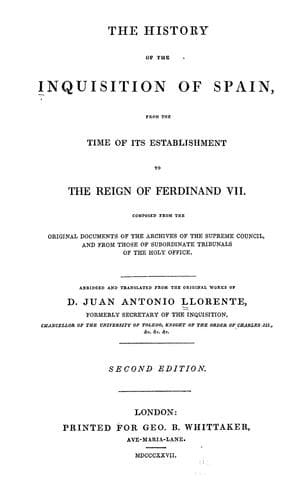
The History of the Inquisition of Spain from the Time of its Establishment to the Reign of Ferdinand VII.Llorente, Juan Antonio
History
The History of the Inquisition of Spain from the Time of its Establishment to the Reign of Ferdinand VII.
Llorente, Juan Antonio
Inquisition -- Spain
The following circumstance shows the injustice and cruelty of the
Inquisition in a strong light. In 1578, a man was condemned, on
suspicion of heresy, to receive two hundred stripes, to be sent for five
years to the galleys, and to pay an hundred ducats. His crime was
sending Spanish horses into France. Since the reign of Alphonso XI., in
the fourteenth century, the introduction of Spanish horses into France
was prohibited, on pain of death and confiscation; the particular
circumstances which caused so disproportionate a punishment to the crime
to be established are not known; it was however renewed in 1499, by
Ferdinand the Catholic. No one will deny that the officers of the
customs were the proper persons to arrest these smugglers; but when the
civil wars broke out between the Catholics and Protestants in France,
Philip thought proper to employ the Inquisition in repressing the
practice, pretending, according to the Papal bull, that those who
furnished the Protestants with arms, ammunition, &c., were favourers of
heretics, and liable to suspicion of heresy. Philip II. commissioned the
Inquisition of Logroño, Saragossa, and Barcelona, to take cognizance of
all the crimes relating to the introduction of Spanish horses into
France.
The Council of the Inquisition added a clause to the annual edict of
denunciations, which obliged every Spanish Catholic Christian to
denounce persons known to have bought horses to send to France, for the
use of the Protestants. Besides these motives of religion, the zeal of
the inhabitants was excited by the promise of a reward.
In 1575, the punishment of whipping was decreed for this crime; but
though the law is expressed in general terms, the following event shows
that it was only inflicted on those whose power and credit were small.
In 1576, a Commissary of the Inquisition met a servant of the viceroy of
Arragon going into France with two horses; he seized the horses, but
allowed the servant to go away. He gave an account of his proceedings to
the inquisitors, who approved of his conduct in not arresting the
servant; their opinion was confirmed by the Supreme Council. The
inquisitors were on the point of writing to the viceroy, to demand an
explanation of the conduct of his servant, and the destination of the
horses, when the council ordered them to desist, if they thought it
would be disagreeable to the viceroy.
This law was afterwards applied to those who were suspected of
smuggling, and to those who favoured the practice. In 1607, Philip II.
ordered the inquisitors to offer rewards to those who intercepted this
trade, and the people were at last inspired with so great a horror of
it, and those who practised it became so odious, that the government was
obliged to declare that the misfortune of being convicted and punished
for this crime, did not exclude a person from enjoying honours and
offices.
Public-domain text, read in full here on John Shaqi.
Reviews
Reviews
No reviews yet
Be the first to share your thoughts on this work.
Elsewhere in the archive
Join the Discussion
Join the discussion
Sign in to leave a comment or review.
Sign InorCreate an account