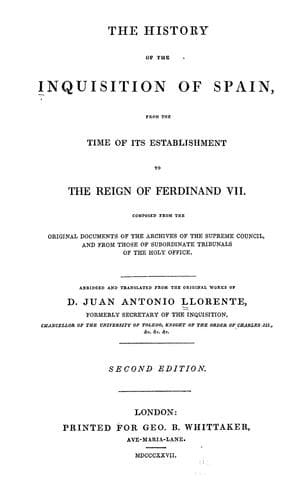
The History of the Inquisition of Spain from the Time of its Establishment to the Reign of Ferdinand VII.Llorente, Juan Antonio
History
The History of the Inquisition of Spain from the Time of its Establishment to the Reign of Ferdinand VII.
Llorente, Juan Antonio
Inquisition -- Spain
The inquisitors, always eager to extend their jurisdiction, wished to
have the right of undertaking the trials for smuggling saltpetre,
sulphur, and gunpowder; this attempt did not succeed, and was, in fact,
the cause of their being deprived of the powers bestowed on them by
Philip, respecting the introduction of horses into France.
_Inquisition of Grenada._
In the yearly _autos-da-fé_ of the Inquisition of Grenada, there
generally appeared about twenty condemned persons; for although the
Morescoes who denounced themselves were treated with great clemency, yet
there were many who refused to accuse themselves, either from the fear
which the severity of the Inquisition inspired, or because they were
persuaded that those who declared they had been treated with great
gentleness, did not dare to assert the contrary; and others, after
having emigrated to Africa, had returned to Spain without considering
the danger they were in of being arrested by the Inquisition.
On the 27th of May, 1593, a grand _auto-da-fé_ took place at Grenada;
five individuals were burnt in person, and five in effigy; eighty-seven
were condemned to penances. The only considerable person among these,
was Donna Inez Alvarez, the wife of Thomas Martinez, alguazil to the
royal chancery. She was condemned to be burnt, but making a confession
on the scaffold, she was reconciled.
The proceedings were the same in the Inquisition of Valencia. The number
of Morescoes who relapsed into Mahometanism, and refused to accuse
themselves, was so considerable, that many appeared in every
_auto-da-fé_, either to be burnt as _impenitent_, or to suffer different
penances.
_Inquisition of Logroño._
The Inquisition of Logroño was not less active in prosecuting heretics.
An _auto-da-fé_ was celebrated every year, composed of about twenty
persons condemned for Judaism, and some others for different heresies,
particularly Lutheranism; for after the time of Don Carlos de Seso,
corregidor of Toro (who was arrested at Logroño, in 1558, and burnt in
the following year at Valladolid), there were always some individuals to
be found who professed his opinions, and succeeded in obtaining Lutheran
books. The council which was informed of this circumstance, wrote to the
inquisitors in 1568, enjoining them to redouble their vigilance in
preventing the introduction of heretical books, and informed them, that
Don Diego de Guzman, ambassador to England, had written that the
Protestants of that country boasted that their doctrine was well
received in Spain, particularly in Navarre, and that it was even
preached there.
Public-domain text, read in full here on John Shaqi.
Reviews
Reviews
No reviews yet
Be the first to share your thoughts on this work.
Elsewhere in the archive
Join the Discussion
Join the discussion
Sign in to leave a comment or review.
Sign InorCreate an account