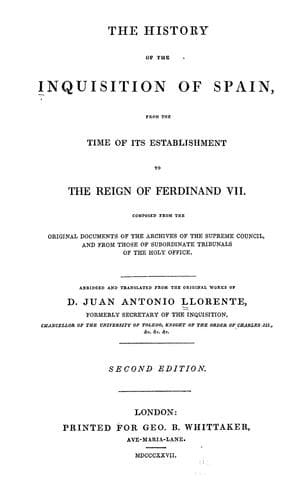
The History of the Inquisition of Spain from the Time of its Establishment to the Reign of Ferdinand VII.Llorente, Juan Antonio
History
The History of the Inquisition of Spain from the Time of its Establishment to the Reign of Ferdinand VII.
Llorente, Juan Antonio
Inquisition -- Spain
While the inquisitors of Logroño were preparing for the _auto-da-fé_ of
1570, they had the mortification of being blamed for their conduct in
two instances by the Supreme Council. One was in the case of Lope de
Arguinaraz, and the other in that of Juan Floristan Maestuz, who were
accused of Judaism. Arguinaraz denied the fact, was tortured, and then
confessed having committed the actions, but asserted that he did not do
them with the sentiments and belief that he was accused of. He ratified
his confession some days after, and demanded reconciliation. The judges
when they assembled to vote for the definitive sentence, resolved to
refer the case to the Supreme Council, which pronounced that they had
not sufficiently examined the accused on the sentiments and intentions
which he entertained in committing the actions he had confessed, and
commanded them to return to that stage of the trial, and vote according
to the result. The inquisitors sent an account of the motives of their
conduct, and gave notice that they should wait until the council had
considered their observations, before they proceeded further. The reply
to this message enjoined the inquisitors to execute the orders they had
received immediately, and harshly reproached them for not having obeyed
them in silence, and for having failed in their duty, in the
interrogation, when they ought to have examined the accused on his
doctrine.
In the other affair of Juan Floristan Maestuz, the council expressed its
surprise, that the inquisitors did not examine the accused on some
heretical propositions which were proved against him, though he refused
to confess even during the torture; and above all, that the inquisitor,
who had qualified the accused as _negatively_ perjured, had voted for
his reconciliation, since the constitutions of the holy office
prohibited the reconciliation of those who persisted denying the charges
proved against him. The reconciliation of the two prisoners took place
in the _auto-da-fé_.
An _auto-da-fé_ took place at Logroño, on the 14th of November, 1593,
where forty-nine persons appeared; five were burnt in person, seven in
effigy; the others were subjected to penances.
The custom of celebrating one _general auto-da-fé_ every year was so
well established, that when the inquisitors of Cuença, in 1558, gave up
a man to secular justice in a _particular auto-da-fé_, it was doubted if
the rules of the holy office permitted it; and though the council
decided in the affirmative, the custom of reserving all the condemned
persons for the general _auto-da-fé_ prevailed, unless any very
particular circumstance made it necessary to deviate from it.
_Inquisition of Sardinia._
Public-domain text, read in full here on John Shaqi.
Reviews
Reviews
No reviews yet
Be the first to share your thoughts on this work.
Elsewhere in the archive
Join the Discussion
Join the discussion
Sign in to leave a comment or review.
Sign InorCreate an account