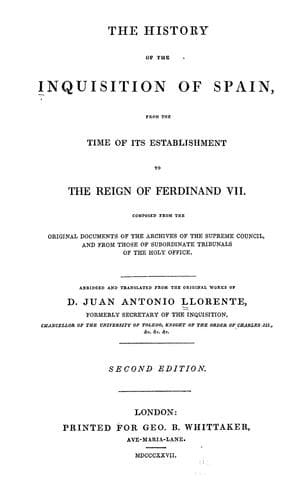
The History of the Inquisition of Spain from the Time of its Establishment to the Reign of Ferdinand VII.Llorente, Juan Antonio
History
The History of the Inquisition of Spain from the Time of its Establishment to the Reign of Ferdinand VII.
Llorente, Juan Antonio
Inquisition -- Spain
I have already stated, that Philip II. introduced the Spanish
constitution into Sardinia, in 1562. Don Diego Calvo first began to put
it into execution, but the novelty made so great an impression on the
inhabitants, that they demanded that the tribunal should be visited.
This commission was confided by the inquisitor-general to the
licentiate, Martinez del Villar, who fulfilled it in 1567. He received
so many complaints against the inquisitor Calvo, that he was recalled,
and Martinez took his place; he, however, did not remain there long, but
was succeeded by Don Alphonso de Lorca.
In 1575, an appeal was made to Rome against the tribunal of Sardinia,
and Philip II. interposed in its defence. Don Francis Minuta, a
Sardinian gentleman, had been subjected to a penance for bigamy, and
condemned to serve for three years as a common soldier in the galleys
of Spain, and without the liberty of going out of the Goletta, in Malta.
He had not been there a month, before he contrived to escape, and
returned to Sardinia; the inquisitor-general then ordered him to be
again arrested, and doubled his punishment; Minuta was taken back to the
Goletta, whence he escaped a second time, and fled to Rome. He
represented to the Pope that he was not guilty of bigamy, and that the
manner in which the inquisitor-general had treated him was unjust, since
he had left the fort with the permission of the governor. Don Francis
demanded, and obtained of the Pope, two briefs of commission: the first
for the examination of the principal question, that of bigamy; the other
to judge of the reasons which he advanced against the sentence, which
prolonged his detention. In the interim, the inquisitor of Sardinia
declared him a contumacious fugitive, and condemned him to eight years'
labour in the galleys. The apostolical judge required the inquisitor to
suspend the proceedings; he informed the inquisitor-general, who applied
to the king, whose interference they had never requested in vain. Philip
II. wrote to Don Juan de Zuñiga, his ambassador at Rome, to demand a
revocation of the briefs of commission, and to obtain permission for the
inquisitor of the island to continue the prosecution, or that it might
at least be referred to the inquisitor-general, to whom the right of
judging the cause belonged. The Pope revoked his bulls to please the
King of Spain, and the unfortunate Don Francis Minuta experienced the
fate which he might have expected; for, in cases of this nature, the
inquisitor-general always delegates one of the members of the accused
tribunal to be the examining judge, on pretence that they are in
possession of the writings of the trial.
Don Andrea Minuta, brother to Don Francis, was also condemned to the
same punishment for three years. He fled to Rome, and appealing to the
Pope, obtained a brief of commission for a bishop of Sardinia. Philip
II. made the same request to the Pope, and Andrea was treated in the
same way as his brother.
Public-domain text, read in full here on John Shaqi.
Reviews
Reviews
No reviews yet
Be the first to share your thoughts on this work.
Elsewhere in the archive
Join the Discussion
Join the discussion
Sign in to leave a comment or review.
Sign InorCreate an account