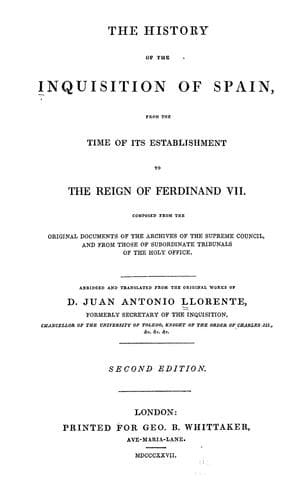
The History of the Inquisition of Spain from the Time of its Establishment to the Reign of Ferdinand VII.Llorente, Juan Antonio
History
The History of the Inquisition of Spain from the Time of its Establishment to the Reign of Ferdinand VII.
Llorente, Juan Antonio
Inquisition -- Spain
Don Pedro Guisa, Baron de Casteli, in Sardinia, was prosecuted and
condemned for the same crime of bigamy; but having learnt what had
happened to the two brothers Minuta, he had recourse to entreaties and
humiliations, to appease the inquisitor-general and obtain a commutation
of his punishment.
CHAPTER XXV.
OF THE LEARNED MEN WHO HAVE BEEN PERSECUTED BY THE INQUISITION.
Among the many evils which the Inquisition has inflicted on Spain, the
obstacles which it opposes to the progress of the arts and sciences, and
literature, are not the least deplorable. The partisans of the holy
office have never allowed this, yet it is a certain truth. The
apologists, of whom I speak, maintain, that the Inquisition only opposes
the invasion of heretical opinions, and leaves those who do not attack
the doctrines of the faith in perfect liberty,--consequently, that it
does not influence the arts and sciences. If this pretension was just,
there are many excellent works which might be read, and which are only
prohibited because they contain doctrines opposed to the opinions of the
scholastic theologians.
St. Augustine was certainly a very zealous partisan of religion in its
greatest purity, yet he made a great distinction between a dogmatic
proposition and one not defined. He acknowledged that in the second case
a Catholic was free to maintain the argument for, or against, according
to the dictates of his reason. St. Augustine did not suppose that the
freedom of opinion would be opposed by such theological censures as the
qualifiers of the holy office have established in modern times. They
have had great influence on the prohibition of books, and even on the
condemnation of their authors. They are employed against the first, on
pretence that they contain propositions _favourable to heresy, ill
sounding, savouring of heresy, fomenting heresy, or tending to heresy_;
against the authors, in declaring them suspected of having adopted
heresy in their hearts.
In the present time the qualifiers have extended the prohibitions, by
saying that the books contained propositions _offensive to persons of
high rank, seditious, tending to disturb public tranquillity, contrary
to the government of the state, and opposed to the obedience which has
been taught by Jesus Christ and his apostles_.
These censures are generally passed by scholastic theologians. The work
of _Filangieri_, entitled _The Science of Legislation_, was censured by
Fray Joseph de Cardenas, a Capuchin, who thought himself competent to do
it, though he had only read the first volume of the Spanish translation,
which contained only half of that of the original.
Public-domain text, read in full here on John Shaqi.
Reviews
Reviews
No reviews yet
Be the first to share your thoughts on this work.
Elsewhere in the archive
Join the Discussion
Join the discussion
Sign in to leave a comment or review.
Sign InorCreate an account