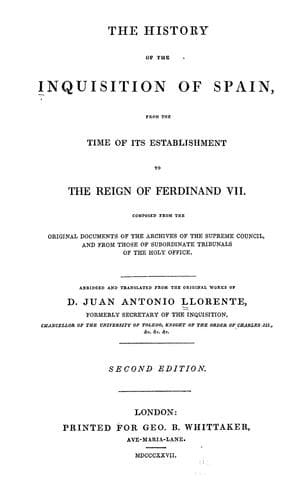
The History of the Inquisition of Spain from the Time of its Establishment to the Reign of Ferdinand VII.Llorente, Juan Antonio
History
The History of the Inquisition of Spain from the Time of its Establishment to the Reign of Ferdinand VII.
Llorente, Juan Antonio
Inquisition -- Spain
The prohibition applies most to those books which treat of theology, and
the canonical laws, particularly if they are well written, and contain
the doctrines taught by the fathers, the councils, and even by the popes
who reigned in the seven first centuries, but which have been forgotten
or opposed by the theologians of the barbarous times, who wished to
establish the system of the union of the two powers in the person of the
sovereign pontiff.
The theological censures likewise attack works on philosophy, on civil
and natural law, and on the people. Those books which have been
published on mathematics, astronomy, physic, and other subjects which
depend upon these, have not been more highly favoured. The Spaniards
have, consequently, been deprived of the advantages which other nations
have derived from all the recent discoveries.
Since the establishment of the holy office, there has scarcely been any
man celebrated for his learning, who has not been prosecuted as a
heretic. In the list which follows, I shall not (unless particular
circumstances render it necessary) include any learned man who has been
prosecuted for having embraced Judaism, Mahometanism, or any sect
equally prohibited by the Catholic religion. Those only will be
mentioned who suffered in their liberty, honour and fortunes, from not
having adopted erroneous scholastic opinions.
The names are disposed in an alphabetical order, that the reader may be
enabled to find the article he wishes to consult more quickly.
_Abady-la-Sierra_ (D. Augustin), bishop of Barbastro. See Chapter 29.
_Abady-la-Sierra_ (D. Manuel), archbishop of Selimbria, _ibid._
_Almodobar_ (Duke of). See following Chapter.
_Aranda_ (Count d'). _Ibid._
_Arellano_ (D. Joseph Xavier Rodriguez d'), archbishop of Burgos. See
Chapter 29.
_Avila_ (the venerable Juan d'), secular priest, born at Almodovar del
Campo, surnamed the Apostle of Andalusia. See Chapters 13 and 14.
_Azara_ (Doctor Nicholas d'). See the following Chapter.
_Balvoa_ (Doctor Juan de), doctoral canon of the cathedral of Salamanca,
and law professor in the university of that city. He was one of the most
distinguished literati of his age. Nicolas Antonio only mentions one of
his works, entitled _Salmantine Lessons_. He composed several others,
one of which would have caused him to be arrested by the Inquisition, if
he had not been protected by the inquisitor-general, Cardinal Don
Antonio Zapata, and by some of the councillors of the tribunal. It was a
memoir which he had drawn up and presented in 1627, to Philip IV., in
the name of the universities of Salamanca, Valladolid and Alcala. The
object of this memoir was to induce the king to refuse the permission
which the Jesuits had requested, to change the _Imperial_ College of
Madrid into a university.
Public-domain text, read in full here on John Shaqi.
Reviews
Reviews
No reviews yet
Be the first to share your thoughts on this work.
Elsewhere in the archive
Join the Discussion
Join the discussion
Sign in to leave a comment or review.
Sign InorCreate an account