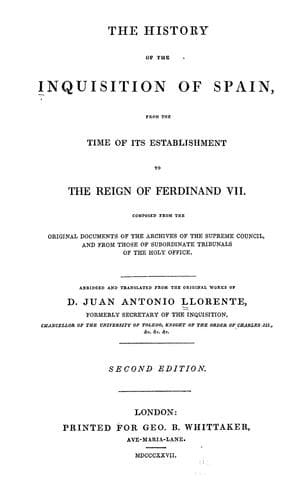
The History of the Inquisition of Spain from the Time of its Establishment to the Reign of Ferdinand VII.Llorente, Juan Antonio
History
The History of the Inquisition of Spain from the Time of its Establishment to the Reign of Ferdinand VII.
Llorente, Juan Antonio
Inquisition -- Spain
The Jesuits denounced the work, and qualified some of the propositions
as _erroneous, offensive to pious ears, scandalous and injurious to the
government, and to the regular ecclesiastics of the Society of Jesus_.
The council caused the memoir to be examined by _qualifiers_, who
declared that it did not merit theological censure, and the council
abandoned the affair. The Jesuits then employed the influence of the
Count Duke d'Olivarez with the king, but the attempt was unsuccessful.
The other work which is attributed to Balvoa, is perhaps that which was
printed at Rome in 1636, in the printing-office of the apostolic
chamber. It is written in Latin, in quarto, and bears the name of
Alphonso de Vargas de Toledo, with this title: _An Exposition made by
Alphonso de Vargas to the Christian Kings and Princes, of the Stratagems
and political Artifices which the Members of the Society of Jesus employ
to establish a universal Monarchy in their favour, a Work which proves
the Deceit of the Jesuits towards the Kings and Nations who have
received them favourably; their Perfidy and Disobedience, even to the
Pope, and the immoderate Desire of Innovation which they have always
shown in Matters of Religion_. It has been said that this work was
printed at Frankfort, with the exception of the justificatory pieces.
The author advances and proves heavy charges against the Jesuits.
_Bails_ (D. Benito), professor of mathematics at Madrid, and author of a
work on that science, used in the schools. The Inquisition instituted
his trial towards the end of the reign of Charles III., as suspected of
atheism and materialism. Bails was deprived of the use of his limbs, and
incapable of attending to his affairs; yet he was arrested and taken to
the prisons of the holy office, with one of his nieces, who obtained
permission to share his captivity, that she might continue to render
him the assistance which his situation rendered necessary. He prepared
his defence in the best manner he was able; and before the publication
of the depositions, he acknowledged enough to show that he was sincere
in his confession and repentance. When he was examined on his internal
belief, he declared that he had had some doubts on the existence of a
God, and the immortality of the soul, but that he had never actually
been an atheist, or a materialist; that during his solitude in the
prison, he had reflected on the subject, and was ready to abjure all
heresies, and particularly those of which he was suspected. He demanded
reconciliation, and a penance, which he promised to accomplish as well
as his health would allow him. His situation was considered; and instead
of sending him to a convent, whither his niece could not have followed
him, he was kept for some time in the secret prisons of the holy office:
he was afterwards removed to his own house, which served for his prison,
and he was obliged to pay for his food during his imprisonment, and
Public-domain text, read in full here on John Shaqi.
Reviews
Reviews
No reviews yet
Be the first to share your thoughts on this work.
Elsewhere in the archive
Join the Discussion
Join the discussion
Sign in to leave a comment or review.
Sign InorCreate an account