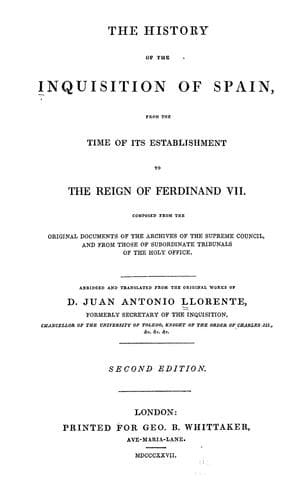
The History of the Inquisition of Spain from the Time of its Establishment to the Reign of Ferdinand VII.Llorente, Juan Antonio
History
The History of the Inquisition of Spain from the Time of its Establishment to the Reign of Ferdinand VII.
Llorente, Juan Antonio
Inquisition -- Spain
to condemn, such as the four propositions of the clergy of France, in
supporting the indirect power of the Court of Rome against that of
kings; and lastly, in sanctioning opinions equally reprehensible. It
might be proved that the tribunal has constantly favoured and encouraged
the wickedness committed by certain ecclesiastics who remain unmolested,
contrary to the respect due to the king and his magistrates. _The
regular priests of the Society of Jesus_ have had the greatest
influence in the holy office, since the minority of Charles II., when
the Jesuit Juan Everard Nitardo, confessor to the queen-mother, was
inquisitor-general.... The last general expurgatory index, published in
1747, is still remembered. _Casani_ and _Carrasco_ (both Jesuits) so
falsified and confused it, that it was a disgrace to the tribunal: the
fact is so well known, and had such important consequences, that that
circumstance alone furnished sufficient motives to suppress the
Inquisition entirely, or at least to reform it, since it only uses its
authority to injure the state, and the purity of morals and the
Christian religion.... It may be said that the expurgatory index drawn
up in Spain is more injurious to the rights of the sovereign and the
instruction of his subjects, than that of Rome. In that court the
qualifiers are well chosen, the prohibitions moderate, and the interests
of individuals are never considered.... We cannot forbear to mention the
memoir presented by Monsignor Bossuet to Louis XIV., against the
inquisitor-general Rocaberti, on the subject of a decree of the
Inquisition of Toledo, in which the doctrine, refusing to the Pope the
direct, or indirect power of depriving sovereigns of their kingdoms, is
declared to be erroneous and schismatic.... The procurators cannot
conceal from themselves that the tribunals of the Inquisition compose
the most fanatical body in the state, and the most attached to the
Jesuits, who have been banished from the kingdom; that the inquisitors
profess the same doctrines and the same maxims; lastly, that it is
necessary to accomplish a reform in the Inquisition."
Public-domain text, read in full here on John Shaqi.
Reviews
Reviews
No reviews yet
Be the first to share your thoughts on this work.
Elsewhere in the archive
Join the Discussion
Join the discussion
Sign in to leave a comment or review.
Sign InorCreate an account