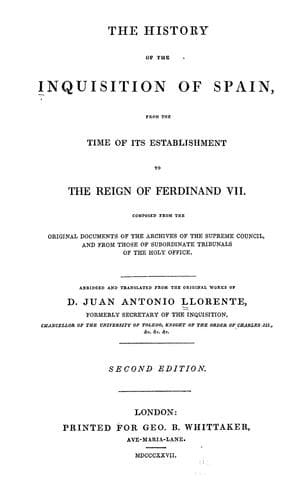
The History of the Inquisition of Spain from the Time of its Establishment to the Reign of Ferdinand VII.Llorente, Juan Antonio
History
The History of the Inquisition of Spain from the Time of its Establishment to the Reign of Ferdinand VII.
Llorente, Juan Antonio
Inquisition -- Spain
In their conclusion, the procurators proposed, that in consideration of
the edict of 1762, and to ensure its execution, the holy office should
be compelled to hear the defence of the authors of the works before they
are prohibited, according to the provision of the bull _Sollicita et
Provida_, of Benedict XIV.; that the tribunal should only condemn those
books which contain errors in doctrine, superstition, or relaxed moral
opinions; that it should particularly avoid prohibiting works written in
the defence of the prerogatives of the crown; that it should not be
allowed to seize or retain any unprohibited book, on pretence of
correcting or qualifying it, but should leave it to the proprietor; that
it should be obliged to present to the king the minutes of the decrees
of prohibition before publication, and to the Council of Castile all the
briefs sent to it, in order that they may be submitted to his majesty
for his approbation.
The Council of Castile, with the extraordinary Council of Archbishops
and Bishops, approved of the opinion of the king's procurators. They
presented it to Charles III., who wished to know the opinion of Don
Manuel de Roda, Marquis de Roda, minister of justice. This nobleman (one
of the most distinguished scholars in Spain, during the last century)
remitted his opinion to his majesty on the 16th of March in the same
year: it entirely accorded with those of the fiscals; he added, "on the
5th of September, 1761, the King of Naples, being informed of what was
passing at Rome concerning the condemnation of Mazengui's work,
commanded that the Inquisition of Sicily and the ecclesiastical
superiors throughout his states should not print or publish, in any way
whatever, any kind of proclamation without permission from his
majesty.... I was then at Rome, and I demanded in your majesty's name
some reparation from his Holiness, for the offence committed by his
nuncio at Madrid, in inducing the inquisitor-general to publish the
brief, for the prohibition of Mazengui's work, without his knowledge....
His Holiness approved of the nuncio's proceedings; but was convinced of
the justice of our complaint, when I supported it by facts and
arguments. The Pope, however, did not dare to express his opinion
openly, as he was entirely governed by Cardinal Torregiani, who had
managed all the intrigues under the influence of the Jesuits....
Torregiani knew that the brief would not be received in any court
either in Italy, France, or even at Venice. The Pope wrote to that
Republic to prevent the work from being reprinted; but it was,
nevertheless, published not only then against the Pope's command, but
afterwards with a dedicatory epistle to his Holiness.... I have seen, in
the library of the Vatican, a printed proclamation of the Inquisition of
Spain in 1693: this tribunal condemns two authors, called the
_Barclayos_, because their books contained two propositions which the
Romans consider heretical: one was, that "_the Pope has no authority
Public-domain text, read in full here on John Shaqi.
Reviews
Reviews
No reviews yet
Be the first to share your thoughts on this work.
Elsewhere in the archive
Join the Discussion
Join the discussion
Sign in to leave a comment or review.
Sign InorCreate an account