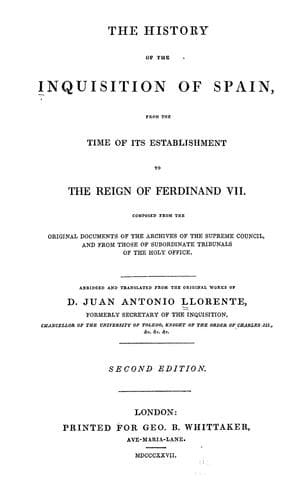
The History of the Inquisition of Spain from the Time of its Establishment to the Reign of Ferdinand VII.Llorente, Juan Antonio
History
The History of the Inquisition of Spain from the Time of its Establishment to the Reign of Ferdinand VII.
Llorente, Juan Antonio
Inquisition -- Spain
over the temporalities of kings, and can neither depose them, nor
release their subjects from their oath of fidelity_; the other, that
_the authority of the general council is greater than that of the
Pope_."
The same minister, in 1776, wrote a letter from Aranjuez to Don Philip
Bertran, inquisitor-general. Speaking with approbation of his intention
to correct the Spanish expurgatory index, he says, "A thousand
absurdities were committed in the last expurgatory (confided in 1747 by
the Bishop of Teruel to two Jesuits), and it is necessary to correct
them; the fact is proved by the denunciations and printed notes of Fray
Martin Llobet. But the appendix, or catalogue of authors called
_Jansenists_, is the most intolerable; the names are all taken from the
_Bibliothèque Janseniste_ of Father Colonia, a Jesuit, which was
condemned by a brief of Benedict XIV. Instead of placing this work in
the Index, as it ought to have been, the names are copied from it. You
know the brief addressed by that Pope to the Bishop of Teruel, on the
31st of July, 1748, and in which he disapproves of the insertion of the
works of Cardinal Noris in the Index. His Holiness also addressed five
letters to Ferdinand VI. on the same subject, but neither the Popes nor
the king could get the name of _Noris_ erased from the Index for ten
years: at that time the Bishop of Teruel (who had at last consented)
died, and, the king dismissed his confessor, the Jesuit Rabago, who had
been the most averse to the measure. I took the necessary steps, and the
king's order was sent to Monsignor Quintano, inquisitor-general, and his
majesty's confessor, with whom I had a long conference on this subject:
I at last obtained a decree, declaring _that the works of Noris had
neither been condemned, censured, nor denounced to the holy office_.
CHAPTER XXVI.
OFFENCES COMMITTED BY THE INQUISITORS AGAINST THE ROYAL AUTHORITY AND
MAGISTRATES.
In addition to the prevention of the progress of literature, the
Inquisition was so much dreaded by the magistrates, that criminals were
frequently left unpunished. Ferdinand and his successors had granted
privileges to this tribunal, which the encroachments of the inquisitors
soon rendered insupportable. They even endeavoured to humiliate three
sovereigns: Clement VIII.; the Prince of Bearn, King of Navarre; and the
Grand Master of the order of St. John of Jerusalem, at Malta. They also
attacked and qualified, as suspected of heresy, the whole Council of
Castile; excited seditions in several cities by their arbitrary
measures; and persecuted several members of their own _Supreme_ Council.
Public-domain text, read in full here on John Shaqi.
Reviews
Reviews
No reviews yet
Be the first to share your thoughts on this work.
Elsewhere in the archive
Join the Discussion
Join the discussion
Sign in to leave a comment or review.
Sign InorCreate an account