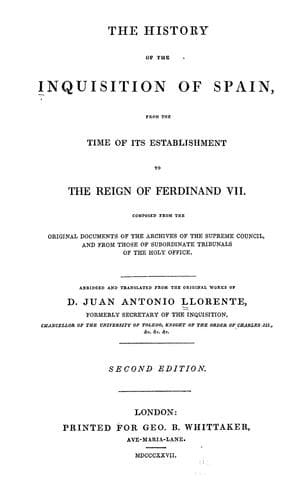
The History of the Inquisition of Spain from the Time of its Establishment to the Reign of Ferdinand VII.Llorente, Juan Antonio
History
The History of the Inquisition of Spain from the Time of its Establishment to the Reign of Ferdinand VII.
Llorente, Juan Antonio
Inquisition -- Spain
This system of domination has never been repressed either by the general
laws of Spain and America, the particular resolutions taken in each of
the kingdoms of the crown of Aragon, the king's ordinations, or the
circular letters of the Council of the Inquisition. The inquisitors have
been punished (though rarely) by being deprived of their offices; this,
however, had no effect. Lastly, the general conventions have not been
less impotent in restraining the ambition which led them to endeavour
to establish their dominion throughout the world by fear.
The Inquisition presents to our view a tribunal, whose judges have
neither obeyed the laws of the kingdom in which it was established, the
bulls of the Popes, the first constitutions of the tribunal, or the
particular orders of its chiefs; which has even dared to resist the
power of the Pope, in whose name it acts, and has disowned the king's
authority eleven different times; which has suffered books to circulate,
favouring regicides and the authority of the Popes to dethrone kings,
and at the same time condemned and prohibited works containing a
contrary doctrine, and defending the rights of the sovereign; which
acted in this manner in circumstances entirely foreign to the crime of
heresy, which was the only one they were competent to judge. Some
examples will be given of the contests for jurisdiction which have so
much injured Spain.
In 1553, the inquisitors of Calahorra excommunicated and arrested the
licentiate Izquierdo, _alcalde-major_ of Arnedo, for having attempted to
prosecute Juan Escudero, a familiar of the holy office, who had
assassinated a soldier. They also ordered divine service to cease at
Arnedo. The Chancery of Valladolid demanded the writings of the trial,
but the inquisitors eluded two of their ordinances. In the mean time the
culprit was left at liberty in the town of Calahorra, and afterwards
made his escape, so that the crime remained unpunished.
In 1567, the inquisitors of Murcia excommunicated the Chapter of the
Cathedral, and the municipality of that city; their competence was
contested, and the Supreme Council decided that some members of the
chapter and municipality should make public reparation in the capital of
the kingdom, and receive absolution; they received it in public, and in
the character of penitents, before the altar.
In 1568, a royal ordinance prescribed the execution of the Convention,
known as that of _Cardinal Espinoza_. It was issued, on the inquisitors
of Valencia claiming the right of judging in affairs concerning the
police of the city and many others, such as contributions, smuggling,
trade, _&c._ They asserted that this right belonged to them,
particularly if one of the individuals concerned in the affair was in
the service of the Inquisition. They would not allow any criminal to be
arrested in the houses of the inquisitors either in the town or country,
while even the churches were no longer a refuge for those they pursued.
Public-domain text, read in full here on John Shaqi.
Reviews
Reviews
No reviews yet
Be the first to share your thoughts on this work.
Elsewhere in the archive
Join the Discussion
Join the discussion
Sign in to leave a comment or review.
Sign InorCreate an account