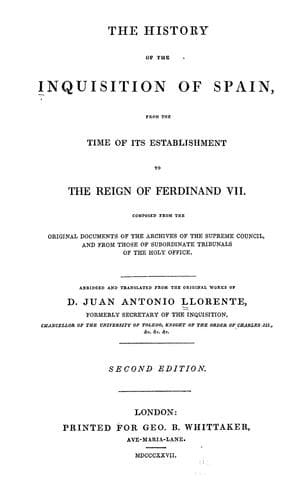
The History of the Inquisition of Spain from the Time of its Establishment to the Reign of Ferdinand VII.Llorente, Juan Antonio
History
The History of the Inquisition of Spain from the Time of its Establishment to the Reign of Ferdinand VII.
Llorente, Juan Antonio
Inquisition -- Spain
In 1569, the tribunal of Barcelona excommunicated and imprisoned the
military deputy and the civil vice-governor of the city, and several of
their people. Their crime was, having exacted from an usher of the
Inquisition a certain privilege called _la Merchandise_. The Royal
Council of Aragon contested the competence of the Council of the
Inquisition; but Philip II. put an end to the dispute, by liberating the
prisoners: the inquisitors were not punished for disobeying the law,
which forbids them to excommunicate a magistrate.
In 1574 the Inquisition of Saragossa excommunicated the members of the
deputation which represented the kingdom of Aragon during the interval
of the assembly of the Cortes. The deputies complained to Pius V., who
paid no attention to them: after his death they applied to his
successor, Gregory XIII. The Pope commissioned the inquisitor-general to
arrange the affair; but, being influenced by the Supreme Council, he
rejected the papal commission, and asserted that the cognizance of the
complaint belonged to him by right. Philip II., that fanatical protector
of the holy office, commanded his ambassador at Rome to defend the
Inquisition to the Pope; and he obtained what he required, while the
deputies were still suffering under the excommunication, which lasted
nearly two years. It must be remarked, that this deputation was composed
of eight persons: two of them were ecclesiastics, generally bishops; two
for the highest order of nobility, who were counts or grandees of
Spain; two gentlemen of illustrious birth to represent the second class
of nobility; and two for the third class, selected from the most
distinguished citizens.
In 1588, the inquisitors of Toledo excommunicated the licentiate Gudiel,
alcalde of the king's house, and judge of the royal court of justice at
Madrid: this magistrate had prosecuted Iñigo Ordoñez, secretary of the
holy office, for having wounded Juan de Berrgos, who died in
consequence, and for having wilfully fired a pistol at the Canon Don
Francis Monsalve. The Council of the Inquisition pleaded the cause of
the culprit before the king, and excused the use of censures, alleging
that _such was the usual proceeding of the holy office_.
In 1591, violent contests took place between the Inquisition of
Saragossa and the chief justice of Aragon. Two seditions were the
result, and several grandees of Spain, many gentlemen, and a still
greater number of private individuals, were condemned to death. An
account of the intrigues of the inquisitors in this affair will be given
in the trial of Antonio Perez.
Public-domain text, read in full here on John Shaqi.
Reviews
Reviews
No reviews yet
Be the first to share your thoughts on this work.
Elsewhere in the archive
Join the Discussion
Join the discussion
Sign in to leave a comment or review.
Sign InorCreate an account