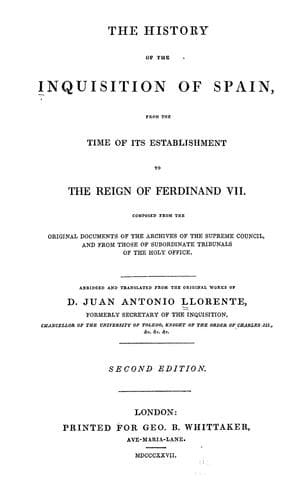
The History of the Inquisition of Spain from the Time of its Establishment to the Reign of Ferdinand VII.Llorente, Juan Antonio
History
The History of the Inquisition of Spain from the Time of its Establishment to the Reign of Ferdinand VII.
Llorente, Juan Antonio
Inquisition -- Spain
If the accused was an impenitent heretic, he was condemned, but the
_auto-da-fé_ was never celebrated until every means had been tried to
convert him; if he was obstinate, he was delivered up to the justice of
the king, and burnt. If the unfortunate heretic had relapsed, it was in
vain for him to return to the true faith; he could not avoid death, and
the only favour shewn him was, that he was first strangled, and
afterwards burnt. Those who escaped from the prisons, or fled to avoid
being arrested, were burnt in effigy.
The tribunal of the Inquisition being ecclesiastical, had originally
only the power of inflicting spiritual punishments; but the laws of the
emperors during the fourth and following centuries, and other
circumstances, caused the inquisitors of the thirteenth century to
assume the right of imposing punishments entirely temporal, except that
of death. The sentence of the Inquisition imposed a variety of fines and
personal penalties; such as entire or partial confiscation; perpetual,
or a limited period of imprisonment; exile, or transportation; infamy,
and the loss of employments, honours, and dignities. Those persons who
abjured as _seriously suspected_ of heresy, were condemned to be
imprisoned for a certain time proportioned to the degree of suspicion.
If the accused was _violently suspected_, he was condemned to perpetual
imprisonment, but the inquisitor had the power of mitigating the
sentence, if he judged that the prisoner repented sincerely. If the
abjurer had been a _formal_ heretic, he was imprisoned for life, and the
inquisitor had not the power of shortening the duration of the
punishment.
Among the punishments to which heretics were condemned, must be
enumerated that of wearing the habit of a penitent, known in Spain under
the name of _San Benito_, which is a corruption of _saco bendito_. Its
real name in Spanish was _Zamarra_. The first became the common name,
because the penitential habit was called _sac_ in the Jewish history.
Before the thirteenth century it was the custom to bless the _sac_ which
was worn in public penance, and hence it derived the epithet of
_bendito_ (blessed). It was a close tunic, made like the cassock of a
priest, with crosses of a different colour affixed to the breast. St.
Dominic and the other inquisitors caused the _reconciled heretics_ to
wear these crosses, as a protection against the Catholics who massacred
all known heretics, although they might be unarmed. The _reconciled
heretics_ wore two crosses to distinguish them from pure Catholics, who
only wore one as crusaders.
CHAPTER V.
ESTABLISHMENT Of THE MODERN INQUISITION IN SPAIN.
Public-domain text, read in full here on John Shaqi.
Reviews
Reviews
No reviews yet
Be the first to share your thoughts on this work.
Join the Discussion
Join the discussion
Sign in to leave a comment or review.
Sign InorCreate an account