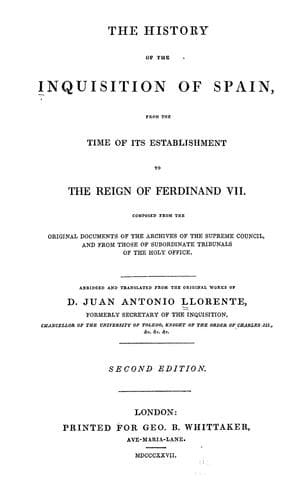
The History of the Inquisition of Spain from the Time of its Establishment to the Reign of Ferdinand VII.Llorente, Juan Antonio
History
The History of the Inquisition of Spain from the Time of its Establishment to the Reign of Ferdinand VII.
Llorente, Juan Antonio
Inquisition -- Spain
The same fate awaited the _converted_ Jew, who might have acquired
certain habits in his infancy, which, though not contrary to
Christianity, might be represented as certain signs of apostacy. The
inquisitors mentioned in their edict several cases where accusation was
commanded. The following cases are so equivocal, that altogether they
would scarcely form a simple presumption in the present time. A convert
was considered as relapsed into heresy, if he kept the sabbath out of
respect to the law which he had abandoned; this was sufficiently proved
if he wore better linen and garments on that day than those which he
commonly used, or had not a fire in his house from the preceding
evening; if he took the suet and fat from the animals which were
intended for his food, and washed the blood from it; if he examined the
blade of the knife before he killed the animals, and covered the blood
with earth; if he blessed the table after the manner of the Jews; if he
has drunk of the wine named caser, (a word derived from caxer, which
means _lawful_,) and which is prepared by Jews; if he pronounces the
bahara, or benediction, when he takes the vessel of wine into his hands,
and pronounces certain words before he gives it to another person; if he
eats of an animal killed by Jews; if he has recited the Psalms of David
without repeating the Gloria Patri at the end; if he gives his son a
Hebrew name chosen among those used by the Jews; if he plunges him seven
days after his birth into a basin containing water, gold, silver,
seed-pearl, wheat, barley, and other substances, pronouncing at the same
time certain words, according to the custom of the Jews; if he draws the
horoscope of his children at their birth; if he performs the ruaya, a
ceremony which consists in inviting his relations and friends to a
repast the day before he undertakes a journey; if he turned his face to
the wall at the time of his death, or has been placed in that posture
before he expired; if he has washed, or caused to be washed, in hot
water the body of a dead person, and interred him in a new shroud, with
hose, shirt, and a mantle, and placed a piece of money in his mouth; if
he has uttered a discourse in praise of the dead, or recited melancholy
verses; if he has emptied the pitchers and other vessels of water in the
house of the dead person, or in those of his neighbours, according to
the custom of the Jews; if he sits behind the door of the deceased as a
sign of grief, or eats fish and olives instead of meat, to honour his
memory; if he remains in his house one year after the death of any one,
to prove his grief. All these articles show the artifice used by the
inquisitors in order to prove to Isabella that a great number of Judaic
heretics existed in the dioceses of Cadiz and Seville. These measures,
so well adapted to multiply victims, could not fail in their effect, and
the tribunal soon began its cruel executions. On the 6th of January,
Public-domain text, read in full here on John Shaqi.
Reviews
Reviews
No reviews yet
Be the first to share your thoughts on this work.
Join the Discussion
Join the discussion
Sign in to leave a comment or review.
Sign InorCreate an account