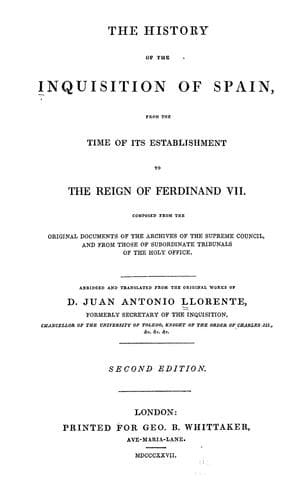
The History of the Inquisition of Spain from the Time of its Establishment to the Reign of Ferdinand VII. — John Shaqi
The History of the Inquisition of Spain from the Time of its Establishment to the Reign of Ferdinand VII.Llorente, Juan Antonio
History
The History of the Inquisition of Spain from the Time of its Establishment to the Reign of Ferdinand VII.
Llorente, Juan Antonio
Inquisition -- Spain
1481, six persons were burnt, seventeen on the 26th of March following,
and a still greater number a month after; on the 4th of November, the
same year, two hundred and ninety-eight _New Christians_ had suffered
the punishment of burning, and seventy-nine were condemned to the
horrors of perpetual imprisonment in the town of Seville alone. In other
parts of the province and in the diocese of Cadiz, two thousand of these
unfortunate creatures were burnt; according to Mariana, a still greater
number were burnt in effigy, and one thousand seven hundred suffered
different canonical punishments.
The great number of persons condemned to be burnt, obliged the prefect
of Seville to construct a scaffold of stone in a field near the town,
name Tablada; it was called Quemadero, and still exists. Four statues,
of plaster, were erected on it, and bore the name of the _Four
Prophets_; the condemned persons were enclosed alive in these figures,
and perished by a slow and horrible death[3].
The dread which these executions inspired in the _New Christians_ caused
a great number to emigrate to France, Portugal, and even to Africa. Many
of those who had been condemned for contumacy had fled to Rome, and
demanded justice of the Pope against their judges. The sovereign pontiff
wrote on the 29th of January to Ferdinand and Isabella, and complained
that the inquisitors did not follow the rule of right in declaring those
to be heretics who were not guilty. His Holiness added that he would
have pronounced their deprivation but from respect to the royal decree
which had instituted them in their office, but he revoked the
authorization which he had given. On the 11th of the following month the
Pope despatched a new brief, in which, without mentioning the first, he
says, the general of the Dominicans, Alphonso de St. Cebriant, having
proved to him the necessity of increasing the number of inquisitors, he
had appointed to that office Alphonso de St. Cebriant, and seven monks
of his order. It was at this time that Queen Isabella requested the Pope
to give the Inquisition a permanent form which should be satisfactory to
all parties; she required that the judgments passed in Spain should be
definitive and without appeal to Rome, and complained at the same time
that many persons accused her of being influenced in all that she did
for the tribunal by a desire to seize the wealth of the condemned.
Public-domain text, read in full here on John Shaqi.
Reviews
Reviews
No reviews yet
Be the first to share your thoughts on this work.
Join the Discussion
Join the discussion
Sign in to leave a comment or review.
Sign InorCreate an account