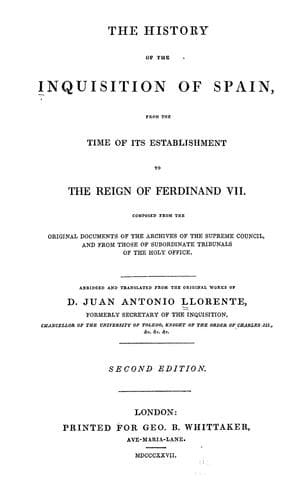
The History of the Inquisition of Spain from the Time of its Establishment to the Reign of Ferdinand VII. — John Shaqi
The History of the Inquisition of Spain from the Time of its Establishment to the Reign of Ferdinand VII.Llorente, Juan Antonio
History
The History of the Inquisition of Spain from the Time of its Establishment to the Reign of Ferdinand VII.
Llorente, Juan Antonio
Inquisition -- Spain
The 17th article obliged the inquisitors to interrogate the witnesses
themselves, if it was not impossible.
The 18th article decrees, that one or two inquisitors should be present
when the prisoner was tortured, or appoint a commissioner if they were
occupied elsewhere, to receive his declarations.
By the 19th article, if the accused did not appear when summoned,
according to the prescribed form, he was condemned as a heretic.
The 20th article decrees, that if it is proved that any person died a
heretic, by his writings or conduct, that he shall be judged and
condemned as such, his body disinterred and burnt, and his property
confiscated.
By the 21st, the inquisitors were commanded to extend their jurisdiction
over the vassals of nobles; if they refused to permit it, they were to
be censured.
The 22nd decreed, that if a man, burnt as a heretic, left children under
age, a portion of their father's property should be granted to them
under the title of alms, and the inquisitors shall be obliged to confide
their education to proper persons.
By the 23rd, if a heretic, reconciled during the term of grace, without
having incurred the punishment of confiscation, possessed property
belonging to a condemned person, this property was not to be included in
the pardon.
The 24th obliged the reconciled to give his Christian slaves their
liberty, when his property was not confiscated, if the king granted the
pardon on that condition.
The 25th prohibited the inquisitors, and other persons attached to the
tribunal, from receiving presents, on pain of excommunication,
deprivation of their employments, restitution, and a penalty of twice
the value of the gifts received.
The 26th recommends to the officers of the Inquisition to live in peace
together.
The 27th commands that they shall carefully watch the conduct of their
inferior officers.
The 28th and last, commits to the prudence of the inquisitors the
discussion of all points not mentioned in the foregoing articles.
Ferdinand having convoked at Tarazona the Cortes of his kingdom of
Aragon, decreed that the Inquisition should be reformed in a
privy-council. After this resolution, Torquemada named Gaspard Juglar, a
dominican, and Peter Arbuès d'Epila, as inquisitors for the
archbishopric of Saragossa. A royal ordinance commanded all the
authorities to aid and assist them in their office, and the magistrate
known by the name of Chief Justice of Aragon, took the oath with
several others. This circumstance did not prevent the resistance which
the Aragonese opposed to the tribunal; on the contrary it augmented, and
rose to such a height, that it might have been termed national.
Public-domain text, read in full here on John Shaqi.
Reviews
Reviews
No reviews yet
Be the first to share your thoughts on this work.
Join the Discussion
Join the discussion
Sign in to leave a comment or review.
Sign InorCreate an account