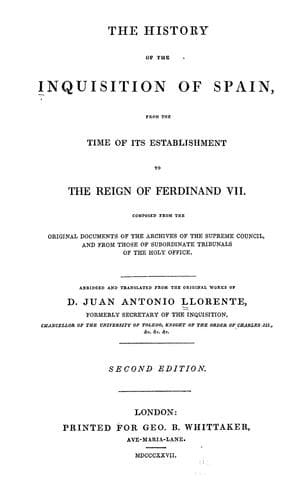
The History of the Inquisition of Spain from the Time of its Establishment to the Reign of Ferdinand VII. — John Shaqi
The History of the Inquisition of Spain from the Time of its Establishment to the Reign of Ferdinand VII.Llorente, Juan Antonio
History
The History of the Inquisition of Spain from the Time of its Establishment to the Reign of Ferdinand VII.
Llorente, Juan Antonio
Inquisition -- Spain
This assembly was held at Seville, and published the first laws of the
Spanish tribunal under the name of instructions in 1484. These
instructions were divided into twenty-eight articles.
The 1st article regulated the manner in which the establishment of the
Inquisition should be announced in the country where it was to be
introduced.
The 2nd article commanded that an edict should be published, accompanied
with censures against those who did not accuse themselves voluntarily
during the term of grace.
By the 3rd, a delay of thirty days was appointed for heretics to declare
themselves.
The 4th regulated that all voluntary confessions should be written in
the presence of the inquisitors and a recorder.
The 5th, that absolution should not be given secretly to any individual
voluntarily confessing, unless no person was acquainted with his crime.
The 6th ordained, that part of the penance of a _reconciled heretic_
should consist in being deprived of all honourable employments, and of
the use of gold, silver, pearls, silk, and fine wool.
By the 7th article, pecuniary penalties were imposed on all who made a
voluntary confession.
By the 8th, the person who accused himself after the term of grace could
not be exempted from the punishment of confiscation.
The 9th article decreed, that if persons under twenty years of age
accuse themselves after the term of grace, and it is proved that they
were drawn into error by their parents, a slight punishment shall be
inflicted.
The 10th obliged the inquisitors to declare, in their act of
reconciliation, the exact time when the offender fell into heresy, that
the portion of property to be confiscated might be ascertained.
The 11th article decreed, that if a heretic, detained in the prisons of
the holy office, demanded absolution, and appeared to feel true
repentance, that it might be granted to him, imposing, at the same time,
perpetual imprisonment.
By the 12th, if the inquisitors thought the repentance of the prisoner
was pretended, in the case indicated by the former article, they were
permitted to refuse the absolution, to declare him a false penitent, and
as such condemn him to be burnt.
By the 13th, if a man, absolved after his confession, should boast of
having concealed several crimes, or if information should be obtained
that he had committed more than he had confessed, he was to be arrested
and judged as a false penitent.
By the 14th article, the accused was to be condemned as impenitent, if
he persisted in his denials even after the publication of the testimony.
By the 15th, if a semi-proof existed against a person who denied his
crime, he was to be put to the torture; if he confessed his crime during
the torture, and afterwards confirmed his confession, he was punished as
convicted; if he retracted, he was tortured again, or condemned to an
extraordinary punishment.
The 16th article prohibited the communication of the entire deposition
of the witnesses to the accused.
Public-domain text, read in full here on John Shaqi.
Reviews
Reviews
No reviews yet
Be the first to share your thoughts on this work.
Join the Discussion
Join the discussion
Sign in to leave a comment or review.
Sign InorCreate an account