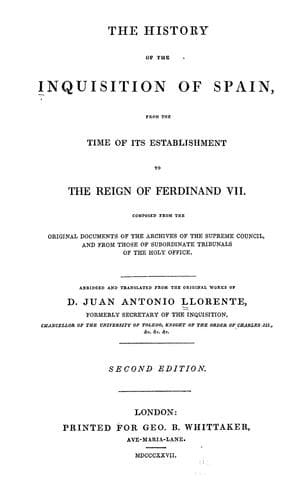
The History of the Inquisition of Spain from the Time of its Establishment to the Reign of Ferdinand VII.Llorente, Juan Antonio
History
The History of the Inquisition of Spain from the Time of its Establishment to the Reign of Ferdinand VII.
Llorente, Juan Antonio
Inquisition -- Spain
When the proof is established, the tribunal publishes the state of the
trial, the depositions, and the act of judgment. But these terms are not
to be understood in the common sense, since the publication was only an
unfaithful copy of the declarations and other facts contained in the
extract formed for the use of the defender. A secretary reads it to the
prisoner in the presence of the inquisitors; after each article he asks
him if he acknowledges the truth of what he has just heard; he then
reads the declarations, and if the prisoner has not yet alleged any
thing against the witnesses, that privilege is given him, because, after
hearing the deposition, he is generally able to designate the person who
has made it.
This reading is only a fresh snare; for if the least contradiction is
perceived, he may be considered guilty of duplicity, concealment, or a
false confession, and the tribunal may refuse to grant the
reconciliation, although he demand it, and even condemn him to
_relaxation_.
_Definitive Censure of the Qualifiers._
After this ceremony the _qualifiers_ are summoned, who receive the
original writing of the sentence passed in the _summary_ instruction,
with the extract of the replies of the prisoner in his last examination,
and the declarations of the witnesses which were communicated to him.
They are commissioned to qualify the propositions a second time, to
examine his explanation, and to decide if his replies have destroyed the
suspicion of heresy which he had incurred, or if he had confirmed it,
and was to be looked upon as a _formal_ heretic.
Every one must be sensible of the importance of this censure, since it
led to the definite sentence; yet the _qualifiers_ scarcely took the
trouble to hear a rapid perusal of the proceedings; they hastily gave
their opinion, and this was the last important act in the proceedings,
as the rest was a mere formality.
_Sentence._
The trial was then considered as finished. The diocesan in ordinary was
convoked, that with the inquisitors he might decide upon the proper
sentence. In the first ages of the holy office these functions were
confided to _consultors_: these were doctors of law, but as they could
only give their opinion, and as the inquisitors pronounced the
definitive sentence, the latter always prevailed if they chanced to
differ. The accused had the right of appealing to the _Supreme_ Council,
but appeals to Rome were more frequent. The inquisitors of the provinces
were afterwards obliged to submit their opinion to the council before
they pronounced the definitive sentence; the council modified and
reformed it; their decision was sent to the inquisitors, who then
established the judgment in their own names, although it might be
contrary to their previous opinion. This proceeding rendered the office
of the consultors useless, and it was discontinued.
Public-domain text, read in full here on John Shaqi.
Reviews
Reviews
No reviews yet
Be the first to share your thoughts on this work.
Elsewhere in the archive
Join the Discussion
Join the discussion
Sign in to leave a comment or review.
Sign InorCreate an account