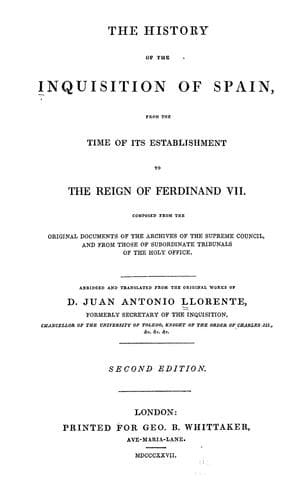
The History of the Inquisition of Spain from the Time of its Establishment to the Reign of Ferdinand VII.Llorente, Juan Antonio
History
The History of the Inquisition of Spain from the Time of its Establishment to the Reign of Ferdinand VII.
Llorente, Juan Antonio
Inquisition -- Spain
The new inquisitor-general was scarcely in possession of his office,
when he began to establish regulations to increase the activity of the
Inquisition. In 1500 he published a constitution in seven articles; and
in 1504 four new articles relative to the confiscations.
To prove his zeal, Deza proposed to Ferdinand that the Inquisition
should be introduced into Sicily and Naples in its present form, and
that it should be under the authority of the Spanish inquisitor-general,
instead of being dependent on the Court of Rome. The king undertook to
introduce it into Sicily by a decree in 1500; but the inhabitants made
great resistance, and he was obliged to pursue the plan which had
succeeded in Aragon, by commanding the viceroy and other magistrates to
assist the inquisitors. Several seditions were quelled before the
sub-delegated inquisitor-general, Don Pedro Velorad, Archbishop of
Messina, could enter upon his office.
In 1516 the Sicilians, weary of the proceedings of the Inquisition,
revolted and set all the prisoners at liberty. Melchior de Cervera, the
inquisitor, only escaped death by a concurrence of extraordinary
circumstances; the viceroy was also in the greatest danger. The
islanders were thus freed from the yoke of this detested tribunal; but
they did not long enjoy liberty, for they were not able to resist the
power of Charles V., who obliged them to receive it a second time.
Naples was more fortunate. Ferdinand, in 1504, commanded the viceroy,
Gonzales Fernandez de Cordova, surnamed _the Great Captain_, to assist
the Archbishop of Messina with all his power, in establishing the
Inquisition; but the Neapolitans opposed it so obstinately, that the
viceroy judged it prudent to desist, and informed the king that it would
be extremely dangerous to combat so decided a resistance.
In 1510 Ferdinand again attempted to introduce the new Inquisition; but
his efforts were unavailing, and he was obliged to declare that he would
be satisfied if the Neapolitans would banish all the _New Christians_
who had taken refuge in their towns when they were driven from Spain.
Deza persuaded Ferdinand and Isabella to introduce the Inquisition into
the kingdom of Grenada, although a promise to the contrary had been made
to the baptized Moors. The queen rejected the proposition, but granted
one that differed little from it, namely, that the jurisdiction of the
inquisitors of Cordova should extend over Grenada, but permitting them
to prosecute only in cases of actual apostasy. From that period the
Moors have been known in history by the name of _Morescoes_.
The principal inquisitor of Cordova was Don Diego de Lucero; the
severity of his character caused great misery throughout the kingdom of
Cordova.
Public-domain text, read in full here on John Shaqi.
Reviews
Reviews
No reviews yet
Be the first to share your thoughts on this work.
Elsewhere in the archive
Join the Discussion
Join the discussion
Sign in to leave a comment or review.
Sign InorCreate an account