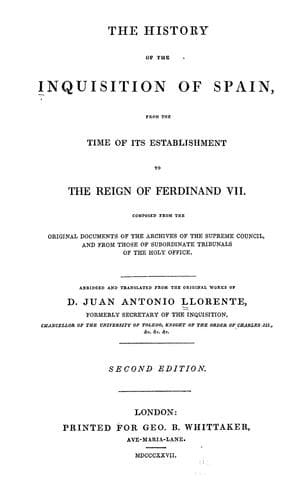
The History of the Inquisition of Spain from the Time of its Establishment to the Reign of Ferdinand VII.Llorente, Juan Antonio
History
The History of the Inquisition of Spain from the Time of its Establishment to the Reign of Ferdinand VII.
Llorente, Juan Antonio
Inquisition -- Spain
In consequence of some events in Aragon, during the period which elapsed
before the bull of confirmation was issued, Leo X. was on the point of
destroying the Inquisition; but intimidated by the policy of Charles V.,
he left the hydra in the same state.
John Prat, the secretary of the Cortes of Aragon, drew up the
proposition of the representatives, and the reply of the king, to be
addressed to the Pope; the chancellor of the king had done the same.
This proceeding particularly displeased the inquisitors of Saragossa;
and to avoid the danger which they believed themselves to be in, they
began to intrigue at court, and soon succeeded in rendering the king
averse to the cause of the deputies of Aragon. They insinuated that Prat
had drawn up the act which was to be sent to Rome, in such a manner, as
to represent the reply of the king as obligatory, not only in the
literal sense of the words, but in supposing that he had admitted the
articles as being conformed to the common law; and that they,
consequently, only wanted the ratification of the Pope, which there was
no doubt of obtaining, as it was known that the deputies of Aragon were
supported by several cardinals, and had sent them considerable sums of
money.
The papers which contained these details were sent to Cardinal Adrian,
who communicated them to the king, and obtained permission to order the
inquisitors of Saragossa to make an inquiry if this recital was true,
when they would be authorized to arrest Prat. Everything happened
according to the hopes of the inquisitors.
Prat was arrested on the 5th of May, 1509, and the next day the king
wrote to the Pope, to request that he would not expedite the bull. It
was intended that the prisoner should be transferred to Barcelona, but
the _permanent deputation_ (who then represented the Aragonese during
the intervals of the assembling of the Cortes) wrote to the king, that
this proceeding was contrary to the statutes which he had sworn to
maintain. The deputation also judged it necessary to convoke a new
Cortes, who represented to the king the dangerous consequences of the
removal of Secretary Prat, whose fidelity had been particularly remarked
during the reign of Ferdinand; and entreated him to set Prat at liberty,
not only because they believed him to be just, faithful, and loyal, but
that it was impossible to levy the supply which had been offered to the
king, unless this request was granted. The king prevented the removal of
the prisoner, but would not liberate him.
Public-domain text, read in full here on John Shaqi.
Reviews
Reviews
No reviews yet
Be the first to share your thoughts on this work.
Elsewhere in the archive
Join the Discussion
Join the discussion
Sign in to leave a comment or review.
Sign InorCreate an account