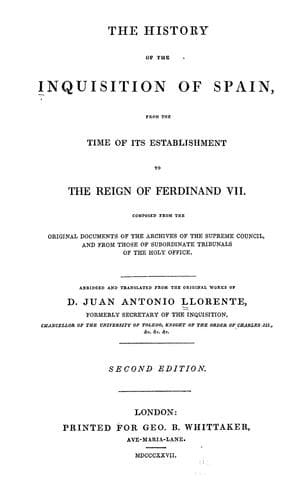
The History of the Inquisition of Spain from the Time of its Establishment to the Reign of Ferdinand VII.Llorente, Juan Antonio
History
The History of the Inquisition of Spain from the Time of its Establishment to the Reign of Ferdinand VII.
Llorente, Juan Antonio
Inquisition -- Spain
The Aragonese, fearing that the Moors dispersed among them would be
subjected to the same laws as those of Valencia, represented to the
emperor, through the medium of his relation the Count de Ribagorza, that
they had never caused any trouble either in politics or religion; that
they could not have any communication with Africa, on account of the
distance of the countries; and that many of them were excellent workmen
in the fabrication of arms, and, consequently, their banishment would
occasion great loss to the kingdom of Aragon. The representations of the
Aragonese were unavailing: the emperor commanded the inquisitors to
subject the Moors of Aragon to the same laws as those of Valencia, and
they were baptized without resistance in 1526.
In 1530 the Pope gave the inquisitor-general, the necessary power to
absolve all the Moors of Aragon as often as they should relapse into
heresy and repent, without inflicting any public penance or infamous
punishments. The motives expressed in the bull for this conduct were,
that they were much sooner converted by gentle means than severity. It
is natural to inquire why a different policy was adopted with respect to
the Jews; they were all rich merchants, while scarcely one in five
thousand was found among the Moors. Occupied in the cultivation of the
ground and the care of their flocks, they were always poor; sometimes
workmen of singular intelligence, talent, and address were found among
them.
The Morescoes of Grenada also occupied the attention of the emperor,
although the events which passed among them were of less importance.
When the emperor was at Grenada in 1526, a memorial from the Morescoes
was presented to him, by Don Ferdinand Benegas, Don Michael d'Aragon and
Diego Lopez Benaxara; they were all members of the municipality, and
illustrious nobles, as they were descended in the direct male line from
the Moorish kings of Grenada. They represented that the Moors suffered
much from the priests, judges, notaries, alguazils, and other Old
Christians. The emperor appeared touched by the recital, and
commissioned a bishop to go into the countries inhabited by the Moors
and examine into the state of religion. The bishop visited the kingdom
of Grenada, and found that the Moors had reason to complain; but he also
discovered that there were scarcely seven Catholics among all these
people; all the others had returned to Mahometanism, either because they
had not been properly instructed, or because they were permitted to
exercise their old religion in public.
Public-domain text, read in full here on John Shaqi.
Reviews
Reviews
No reviews yet
Be the first to share your thoughts on this work.
Elsewhere in the archive
Join the Discussion
Join the discussion
Sign in to leave a comment or review.
Sign InorCreate an account