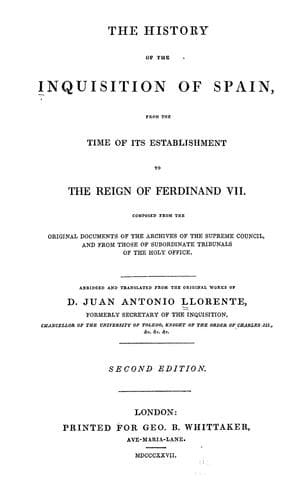
The History of the Inquisition of Spain from the Time of its Establishment to the Reign of Ferdinand VII.Llorente, Juan Antonio
History
The History of the Inquisition of Spain from the Time of its Establishment to the Reign of Ferdinand VII.
Llorente, Juan Antonio
Inquisition -- Spain
The emperor convoked a council, which decreed that the inquisitorial
tribunal of Jaen should be transferred to Grenada. Several other
measures were adopted and approved by the emperor; the most important
was a promise of pardon to the Moors for all that had passed, and a
notice that they would be treated with the utmost severity, if they
again relapsed into heresy. The Morescoes submitted, and obtained for
eighty thousand ducats the privileges of wearing the costume of their
nation, and that the Inquisition should not be allowed to seize their
property if they relapsed.
The inquisitors of Grenada celebrated an _auto-da-fé_ in 1528 with the
greatest ceremony, in order to inspire the Moors with more respect and
fear. However no Moors were burnt, but only baptized Jews who had
returned to Judaism.
The Moors still continued to emigrate to Africa, although they were
treated with moderation. Philip II. obtained a brief from Paul IV., by
which the confessors were authorized to absolve the Moors secretly,
without imposing any penance or pecuniary penalty, on the condition that
they demanded absolution voluntarily. The system of indulgence which bad
been adopted did not prevent Louis Albosein from being condemned to the
flames. After emigrating to Africa, he returned to Valencia with several
other renegadoes, with the intention of exciting the Morescoes to a
revolt; the plot was discovered, the conspirators disarmed, and Louis
was burnt in 1562.
In 1567 the Pope expedited a brief in favour of the Morescoes of
Valencia, but those of Grenada revolted, and elected for their king Don
Ferdinand Valor, a descendant of their former sovereigns of the dynasty
of Abenhumeyas. This rebellion continued for some time; and Philip II.
endeavoured to quell it by issuing edicts of pardon even for those
crimes which came under the jurisdiction of the Inquisition. An amnesty
was granted to the Moors on condition that they came to solicit it, and
many took advantage of the permission. To prevent emigration, the king
remitted the penalty of confiscation, but the inquisitors, by means of
the impenetrable secrecy which they always preserved, rendered the
benevolent intentions of the sovereign of no avail. They did not publish
the briefs of indulgence granted by the Court of Rome, knowing that a
great number of the _relapsed_ would take advantage of them; these
people, not being aware of their privileges, were condemned and burnt.
These examples of cruelty increased the hatred of the Moors for this
sanguinary tribunal, and were the cause of many seditions, which, in
1609, led to the entire expulsion of the Moors, to the number of a
million souls; so that in the space of an hundred and thirty-nine years
the Inquisition deprived the kingdom of Spain of three millions of
inhabitants, Jews, Morescoes, and Moors.
CHAPTER XIII.
OF THE PROHIBITION OF BOOKS AND OTHER ARTICLES.
Public-domain text, read in full here on John Shaqi.
Reviews
Reviews
No reviews yet
Be the first to share your thoughts on this work.
Elsewhere in the archive
Join the Discussion
Join the discussion
Sign in to leave a comment or review.
Sign InorCreate an account