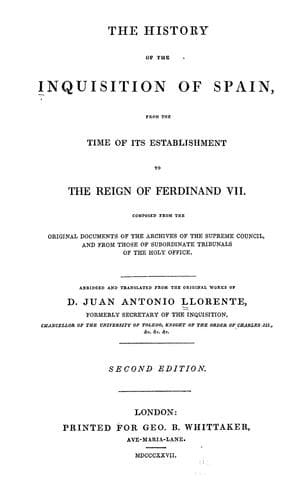
The History of the Inquisition of Spain from the Time of its Establishment to the Reign of Ferdinand VII.Llorente, Juan Antonio
History
The History of the Inquisition of Spain from the Time of its Establishment to the Reign of Ferdinand VII.
Llorente, Juan Antonio
Inquisition -- Spain
The opinions of Luther, Carolstadt, Zuingle, OEcolampadius,
Melancthon, Muncer, and Calvin, were first promulgated during the
ministry of Don Alphonso Manrique, the fifth inquisitor-general. These
reformers were called _Protestants_ after the imperial diet at Spire, in
1529.
Leo the Xth had already condemned the opinions of Luther as heretical,
which induced Manrique to enact severe punishments for those who should
openly maintain or write in favour of them.
In 1490 several Hebrew bibles and books written by Jews were burnt at
Seville; at Salamanca more than six thousand volumes of magic and
sorcery were committed to the flames. In 1502 Ferdinand and Isabella
appointed the presidents of the Chanceries of Valladolid and Ciudad
Real, the Archbishops of Seville, Toledo, Grenada, the Bishops of
Burgos, Salamanca, and Zamora, to decide on all affairs relating to the
examination, censure, printing, introduction, or sale of books. In 1521
the Pope wrote to the governors of the provinces of Castile during the
absence of Charles V., recommending them to prevent the introduction of
the works of Luther into the kingdom; and Cardinal Adrian, in the same
year, ordered the inquisitors to seize all books of that nature: this
order was repeated in 1523.
In 1530 the _Supreme_ Council wrote to the inquisitors during the
absence of Cardinal Manrique, on the necessity of executing the measures
which had been ordained; adding, that information had been received that
the writings of Luther had been introduced into the Kingdom under
fictitious titles, or as works entirely composed by Catholics authors;
and in order to repress this intolerable abuse, they were commanded to
visit all public libraries for those books, and to add to the edict of
denunciation, a particular article, to oblige all Catholics to denounce
any person who might read or keep them in their houses. In 1535 Cardinal
Manrique addressed an order to the inquisitors, and another in the same
year prohibiting the universities of the kingdom from explaining,
reading, or even selling the _Colloquies of Erasmus_. In 1528 he
anathematised some other works of the same author, although he had
defended him in 1527, in an assembly which met to examine his writings.
Erasmus was considered in Spain as a supporter of the Catholic faith
against the doctrine of Luther, and his enemies were only a few
scholastic theologians, who were not acquainted with the Greek and
Hebrew tongues. The Spanish theologians who wrote against him were,
Diego Lopez de Zuñiga, Sancho de Carranza, professor of theology in the
university of Alcala de Henarés, Brother Louis de Carjaval, a
Franciscan, Edward Lee, the English ambassador, and Pedro Vittoria, a
theologian of Salamanca.
Public-domain text, read in full here on John Shaqi.
Reviews
Reviews
No reviews yet
Be the first to share your thoughts on this work.
Elsewhere in the archive
Join the Discussion
Join the discussion
Sign in to leave a comment or review.
Sign InorCreate an account