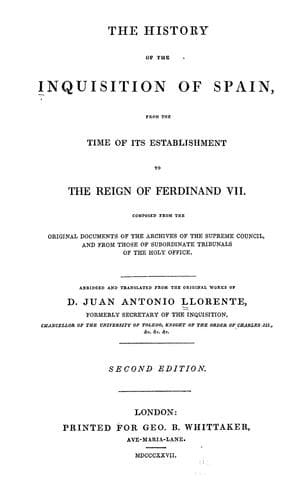
The History of the Inquisition of Spain from the Time of its Establishment to the Reign of Ferdinand VII.Llorente, Juan Antonio
History
The History of the Inquisition of Spain from the Time of its Establishment to the Reign of Ferdinand VII.
Llorente, Juan Antonio
Inquisition -- Spain
After this first attack, in the Lent of the year 1527, two monks
denounced several propositions in the works of Erasmus, as heretical.
Alphonso Manrique (although he was then the friend of Erasmus) was
obliged to submit these propositions to the examination of qualifiers;
but he appointed the most learned men of the kingdom to that office.
This assembly of doctors lasted two months, when the plague, which then
desolated some parts of the kingdom, obliged them to separate, before
they had decided on the judgment to be pronounced; it appears from
several letters written by Erasmus about that time that he hoped it
would be favourable to him.[4]
But the Supreme Council qualified his _Colloquies_, his _Eulogy of
Folly_, and his _Paraphrase_, and prohibited them from being read. In
later times, this prohibition was extended to several other books of the
same author, and the Inquisition recommended in its edicts that the
works of Erasmus should be read with caution.
The emperor Charles V. commissioned the University of Louvain to form a
list of dangerous books, and in 1539 he obtained a bull of approbation
from the Pope. The index was published in 1546 by the university in all
the states of Flanders, six years after a decree had been issued to
prohibit the writings of Luther from being read or bought on pain of
death.[5]
This severe measure displeased all ranks. The princes of Germany openly
complained of it, and offered to assist Charles in his war against the
Turks, if he would allow the people liberty in matters of religion.
Charles paid no attention to their remonstrances, and this bad policy
accelerated the progress of Lutheranism.
In 1549, the inquisitor-general, with the approbation of the Supreme
Council, added some new works to the list of those which had been
prohibited, and addressed two ordinances to the inquisitors, enjoining
them in the first, not to allow any person to possess them, and in the
second, commanding the consultors of the holy office neither to read nor
keep them, though the execution of the decrees might throw them into
their hands.
In 1546 the emperor commanded the University of Louvain to publish the
index, with additions. This work appeared in 1550, and the prince
remitted it to the inquisitor-general, and it was printed by the order
of the Supreme Council, with a supplement composed of books prohibited
in Spain; some time after the council framed another index, which was
certified by the secretary.
All the Inquisitions received copies, and a bull from Julius III., which
renewed the prohibitions and revoked the permissions contrary to the new
bulls: he charged the inquisitors to seize as many books as they could;
to publish prohibitory edicts, accompanied by censures; to prosecute
those who did not obey them, as suspected of heresy; and to give an
account of the books which they had read and preserved.
Public-domain text, read in full here on John Shaqi.
Reviews
Reviews
No reviews yet
Be the first to share your thoughts on this work.
Elsewhere in the archive
Join the Discussion
Join the discussion
Sign in to leave a comment or review.
Sign InorCreate an account