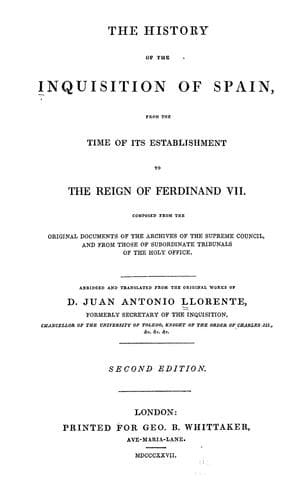
The History of the Inquisition of Spain from the Time of its Establishment to the Reign of Ferdinand VII.Llorente, Juan Antonio
History
The History of the Inquisition of Spain from the Time of its Establishment to the Reign of Ferdinand VII.
Llorente, Juan Antonio
Inquisition -- Spain
Secrecy, the foe of truth and justice, was the soul of the tribunal of
the Inquisition; it gave to it new life and vigour, sustained and
strengthened its arbitrary power, and so emboldened it, that it had the
hardihood to arrest the highest and noblest in the land, and enabled it
to deceive, by concealing facts, popes, kings, viceroys, and all
invested with authority by their sovereign. This _holy office_, veiled
by secrecy, unhesitatingly kept back, falsified, concealed, or forged
the reports of trials, when compelled to open their archives to popes or
kings. The Inquisitors constantly succeeded, by this detestable knavery,
in concealing the truth, and facilitated their object by being careful
not to number the reports. This was practised to a great extent in the
trials of the archbishop of Toledo, of the Prothonotary, and others.
Facts prove beyond a doubt, that the extirpation of Judaism was not the
real cause, but the mere pretext, for the establishment of the
Inquisition by Ferdinand V. The true motive was to carry on a vigorous
system of confiscation against the Jews, and so bring their riches into
the hands of the government. Sixtus IV. sanctioned the measure, to gain
the point dearest to the court of Rome, an extent of domination. Charles
V. protected it from motives of policy, being convinced it was the only
means of preventing the heresy of Luther from penetrating into Spain.
Philip II. was actuated by superstition and tyranny to uphold it; and
even extended its jurisdiction to the excise, and made the exporters of
horses into France liable to seizure by the officers of the tribunal, as
persons suspected of heresy! Philip III., Philip IV., and Charles II.,
pursued the same course, stimulated by similar fanaticism and
imbecility, when the re-union of Portugal to Spain led to the discovery
of many Jews. Philip V. maintained the Inquisition from considerations
of mistaken policy, inherited from Louis XIV., who made him believe that
such rigour would ensure the tranquillity of the kingdom, which was
always in danger when many religions were tolerated. Ferdinand VI. and
Charles III. befriended this _holy office_, because they would not
deviate from the course that their father had traced, and because the
latter hated the freemasons. Lastly, Charles IV. supported the tribunal,
because the French Revolution seemed to justify a system of
surveillance, and he found a firm support in the zeal of the
inquisitors-general, always attentive to the preservation and extension
of their power, as if the sovereign authority could find no surer means
of strengthening the throne, than the terror inspired by an
Inquisition.
_During the time I remained in London, I heard some Catholics affirm
that the Inquisition was useful in Spain, to preserve the Catholic
faith, and that a similar establishment would have been useful in
France._
Public-domain text, read in full here on John Shaqi.
Reviews
Reviews
No reviews yet
Be the first to share your thoughts on this work.
Join the Discussion
Join the discussion
Sign in to leave a comment or review.
Sign InorCreate an account