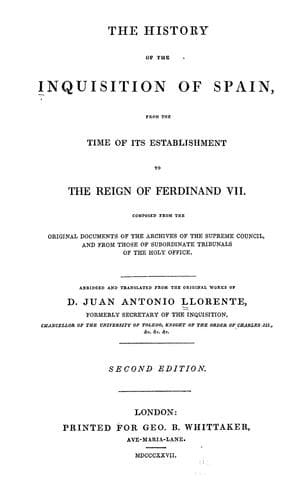
The History of the Inquisition of Spain from the Time of its Establishment to the Reign of Ferdinand VII.Llorente, Juan Antonio
History
The History of the Inquisition of Spain from the Time of its Establishment to the Reign of Ferdinand VII.
Llorente, Juan Antonio
Inquisition -- Spain
These persons were deceived, by believing that it was sufficient for
people to be good Catholics not to have any fear of the _holy office_.
They knew not that nine-tenths of the prisoners were deemed guilty,
though true to their faith, because the ignorance or malice of the
denouncers prosecuted them for points of doctrine, which were not
susceptible of heretical interpretation, but in the judgment of an
illiterate monk, is considered erudite by the world, because he is said
to have studied the theology of the schools. The Inquisition encouraged
hypocrisy, and punished those who either did not know how, or would not,
assume the mask. This tribunal wrought no conversion. The Jews and
Morescoes, who were baptized without being truly converted, merely that
they might remain in Spain, are examples which prove the truth of this
assertion. The former perished on the pyres of the Inquisition, the
latter crossed over into Africa with the Moors, as much Mahometans as
their ancestors were before they were baptised.
I conclude with declaring that the contents of this history are
original; and that I have drawn my facts with fidelity, from the most
authentic sources, and might have greatly extended them[1].
HISTORY OF THE INQUISITION.
CHAPTER I.
FIRST EPOCH OF THE CHURCH TILL THE CONVERSION OF THE EMPEROR
CONSTANTINE.
The Christian religion was scarcely established before heresies arose
among its disciples. The Apostle St. Paul instructs Titus, the Bishop of
Crete, in his duty towards heretics, saying, that a man who persists in
his heresy, after the first and second admonition, shall be rejected:
but St. Paul does not say that the life of the heretic shall be taken;
and our Saviour, addressing St. Peter, commands that a sinner shall be
forgiven, not only seven times, but seventy times seven, which infers
that he ought never to be punished with death by a judgment of the
church. Such was the doctrine of the church during the three first
centuries, until the peace of Constantine. Heretics were never
excommunicated until exhortation had been employed in vain. As this
system was adopted, it was natural that some persons should write
against heresy to prevent its increase. This was done by St. Ignatius,
Castor Agrippa, St. Irenæus, St. Clement of Alexandria, St. Justin, St.
Denis of Corinth, Tertullian, Origen, and many others.
These faithful imitators of the benevolence of their Divine Master were
averse to oppressive measures. Although the evil produced by the
religion of the impious Manès was so great, that Archelaüs, Bishop of
Caschara, in Mesopotamia, judged it necessary to imprison him, yet he
renounced that design when Marcellus (to whom Manès had written)
proposed another conference with him. Archelaüs succeeded in converting
the heretic, and not only gave up his intention of detaining him, but
saved his life when the people would have stoned him to death.
Public-domain text, read in full here on John Shaqi.
Reviews
Reviews
No reviews yet
Be the first to share your thoughts on this work.
Join the Discussion
Join the discussion
Sign in to leave a comment or review.
Sign InorCreate an account