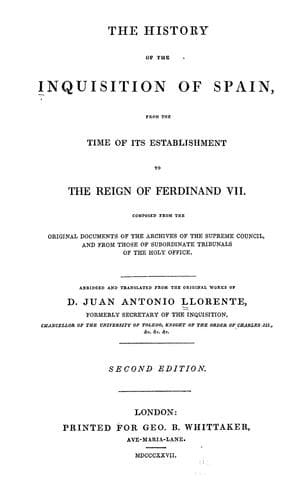
The History of the Inquisition of Spain from the Time of its Establishment to the Reign of Ferdinand VII.Llorente, Juan Antonio
History
The History of the Inquisition of Spain from the Time of its Establishment to the Reign of Ferdinand VII.
Llorente, Juan Antonio
Inquisition -- Spain
The Pope added, that he was informed that a great number were in the
possession of librarians and private persons, particularly the Spanish
Bibles mentioned in the catalogue, and the Missal and Diurnal in the
supplement.
The Council of Trent, after acknowledging the necessity of treating the
writings of heretics with great severity, commissioned the celebrated
Carranza to compose the catalogue. After having examined the great
number of books submitted to the council, he sent all those which did
not contain any thing reprehensible to the Dominican convent in the city
of Trent, and caused the rest to be burnt, or torn, and thrown into the
Adige.[6] Carranza soon after accompanied Philip II. to England, where
he not only converted many Lutherans, but caused many bibles which had
been translated to be burnt.
Some bibles, which had been introduced into Spain, and were not upon the
list, were also prohibited; and the inquisitors were commanded to
publish the interdict, and to employ severe measures against those who
refused to obey it. The ordinances of the Council of Castile, composed
by the order of the king, and approved by him, were published in the
same year; they gave the council the privilege of permitting books to be
printed, on the condition that they should be examined previously, if
the subject of which they treated was important.
Charles V. and Philip II. had regulated the circulation of books in
their American states. In 1543 the viceroys and other authorities were
commanded to prevent the introduction or printing of tales and romances.
In 1550 a new decree obliged the tribunal of the commerce of Seville to
register all the books destined for the colonies, to certify that they
were not prohibited.
In 1556 the government commanded that no work relating to the affairs of
America should be published without a permission from the council of the
Indies, and that those already printed should not be sold unless they
were examined and approved, which obliged all those who possessed any to
submit them to the council. The officers of the customs in America were
also obliged to seize all the prohibited books which might be imported,
and remit them to the archbishops and bishops, who, in this case,
possessed the same powers as the inquisitors of Spain.
Lastly, Philip II. in 1560 decreed new measures, and the _surveillance_
was afterwards as strictly observed in the colonies of the New World as
in the Peninsula.
Public-domain text, read in full here on John Shaqi.
Reviews
Reviews
No reviews yet
Be the first to share your thoughts on this work.
Elsewhere in the archive
Join the Discussion
Join the discussion
Sign in to leave a comment or review.
Sign InorCreate an account