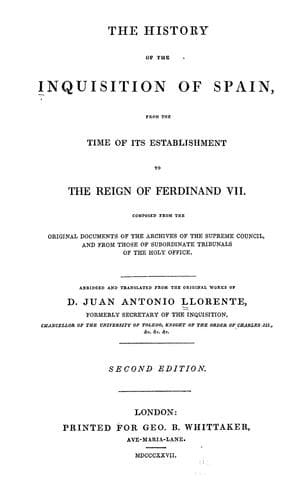
The History of the Inquisition of Spain from the Time of its Establishment to the Reign of Ferdinand VII.Llorente, Juan Antonio
History
The History of the Inquisition of Spain from the Time of its Establishment to the Reign of Ferdinand VII.
Llorente, Juan Antonio
Inquisition -- Spain
Yet the council, on the 30th August, 1537, decreed that the time and
place of the events should be inserted in the extract of the publication
of the depositions, because it was of consequence to the interests of
the accused; it would be done even in supposing that he would learn from
it the names of the witnesses.
This rule is too contrary to the inquisitorial system, not to inspire a
wish to seek for the principle and the cause; it may be found in the bad
reputation which the Inquisition had acquired by the proceedings against
Alphonso Virues, which induced Charles V. to deprive it of the royal
jurisdiction: but although the council registered the order of the
sovereign, he decreed, on the 15th of December, in this year, and on the
22nd of February, 1538, that the extract should not contain any article
which could make known the witnesses; thus annulling the order imposed
in the preceding year. During the last years of the Inquisition, neither
the time nor place were indicated in the act of the publication of the
depositions.
In June, 1537, the council being consulted by the Inquisition of Toledo,
decreed, as general rules--1st, that all who _calmly_ uttered the
blasphemies, _I deny God, I abjure God_, should be punished severely;
but those who uttered these words in anger, should not be subject to
prosecution: 2nd, to punish all Christians accused of bigamy, if the
guilty person supposed it permitted; and in the contrary case to abstain
from prosecution; 3rdly, to ascertain, in cases of sorcery, if there had
been any compact with the devil; if the compact had existed, the
Inquisition was directed to judge the accused--if it had not, they were
to leave the cause to the secular tribunals.
The second and third of these regulations are contrary to the system of
the holy office, which leads me to suppose that the temporary disgrace
and exile of Manrique contributed to this moderation, which could not
last long: the inquisitors have always proceeded against persons guilty
of these crimes, on the pretence of examining if any circumstance might
cause suspicion of heresy. The same spirit is found in another order of
the 19th February, 1533: it obliges the inquisitors to receive all the
papers which the relations of the accused wish to communicate to them.
The council made this rule, because these writings (though useless on
the trial) might yet be serviceable in proving the innocence or guilt of
the accused.
On the 10th May, 1531, the council decreed, that if bulls of
dispensation from the use of the _San-benito_, imprisonment, or other
punishments, were presented to the Inquisition, the procurator-fiscal
should demand that they should be suppressed, as well as those obtained
by the children and grandchildren of persons declared infamous by the
holy office: the council supported this rule by alleging that children
always followed the example of their heretical ancestors, and that it
was a scandal to see them occupying honourable employments.
Public-domain text, read in full here on John Shaqi.
Reviews
Reviews
No reviews yet
Be the first to share your thoughts on this work.
Elsewhere in the archive
Join the Discussion
Join the discussion
Sign in to leave a comment or review.
Sign InorCreate an account