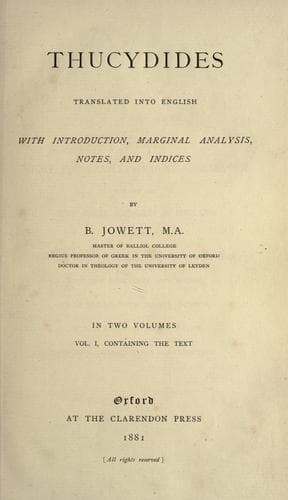
Greece -- History -- Peloponnesian War, 431-404 B.C.
Meanwhile the commons in Corcyra, being still in great fear of the
fleet attacking them, came to a parley with the suppliants and their
friends, in order to save the town; and prevailed upon some of them to
go on board the ships, of which they still manned thirty, against the
expected attack. But the Peloponnesians after ravaging the country
until midday sailed away, and towards nightfall were informed by beacon
signals of the approach of sixty Athenian vessels from Leucas, under
the command of Eurymedon, son of Thucles; which had been sent off by
the Athenians upon the news of the revolution and of the fleet with
Alcidas being about to sail for Corcyra.
The Peloponnesians accordingly at once set off in haste by night for
home, coasting along shore; and hauling their ships across the Isthmus
of Leucas, in order not to be seen doubling it, so departed. The
Corcyraeans, made aware of the approach of the Athenian fleet and of
the departure of the enemy, brought the Messenians from outside the
walls into the town, and ordered the fleet which they had manned to
sail round into the Hyllaic harbour; and while it was so doing, slew
such of their enemies as they laid hands on, dispatching afterwards, as
they landed them, those whom they had persuaded to go on board the
ships. Next they went to the sanctuary of Hera and persuaded about
fifty men to take their trial, and condemned them all to death. The
mass of the suppliants who had refused to do so, on seeing what was
taking place, slew each other there in the consecrated ground; while
some hanged themselves upon the trees, and others destroyed themselves
as they were severally able. During seven days that Eurymedon stayed
with his sixty ships, the Corcyraeans were engaged in butchering those
of their fellow citizens whom they regarded as their enemies: and
although the crime imputed was that of attempting to put down the
democracy, some were slain also for private hatred, others by their
debtors because of the moneys owed to them. Death thus raged in every
shape; and, as usually happens at such times, there was no length to
which violence did not go; sons were killed by their fathers, and
suppliants dragged from the altar or slain upon it; while some were
even walled up in the temple of Dionysus and died there.
Public-domain text, read in full here on John Shaqi.
Reviews
Reviews
No reviews yet
Be the first to share your thoughts on this work.
Elsewhere in the archive
Join the Discussion
Join the discussion
Sign in to leave a comment or review.
Sign InorCreate an account