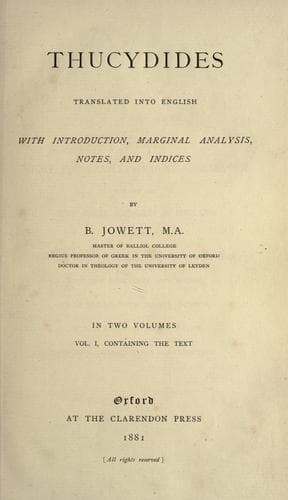
Greece -- History -- Peloponnesian War, 431-404 B.C.
At last, after many had been already wounded in the confined space in
which they were fighting, they formed in close order and retired on the
fort at the end of the island, which was not far off, and to their
friends who held it. The moment they gave way, the light troops became
bolder and pressed upon them, shouting louder than ever, and killed as
many as they came up with in their retreat, but most of the
Lacedaemonians made good their escape to the fort, and with the
garrison in it ranged themselves all along its whole extent to repulse
the enemy wherever it was assailable. The Athenians pursuing, unable to
surround and hem them in, owing to the strength of the ground, attacked
them in front and tried to storm the position. For a long time, indeed
for most of the day, both sides held out against all the torments of
the battle, thirst, and sun, the one endeavouring to drive the enemy
from the high ground, the other to maintain himself upon it, it being
now more easy for the Lacedaemonians to defend themselves than before,
as they could not be surrounded on the flanks.
The struggle began to seem endless, when the commander of the
Messenians came to Cleon and Demosthenes, and told them that they were
losing their labour: but if they would give him some archers and light
troops to go round on the enemy’s rear by a way he would undertake to
find, he thought he could force the approach. Upon receiving what he
asked for, he started from a point out of sight in order not to be seen
by the enemy, and creeping on wherever the precipices of the island
permitted, and where the Lacedaemonians, trusting to the strength of
the ground, kept no guard, succeeded after the greatest difficulty in
getting round without their seeing him, and suddenly appeared on the
high ground in their rear, to the dismay of the surprised enemy and the
still greater joy of his expectant friends. The Lacedaemonians thus
placed between two fires, and in the same dilemma, to compare small
things with great, as at Thermopylae, where the defenders were cut off
through the Persians getting round by the path, being now attacked in
front and behind, began to give way, and overcome by the odds against
them and exhausted from want of food, retreated.
The Athenians were already masters of the approaches when Cleon and
Demosthenes perceiving that, if the enemy gave way a single step
further, they would be destroyed by their soldiery, put a stop to the
battle and held their men back; wishing to take the Lacedaemonians
alive to Athens, and hoping that their stubbornness might relax on
hearing the offer of terms, and that they might surrender and yield to
the present overwhelming danger. Proclamation was accordingly made, to
know if they would surrender themselves and their arms to the Athenians
to be dealt at their discretion.
Public-domain text, read in full here on John Shaqi.
Reviews
Reviews
No reviews yet
Be the first to share your thoughts on this work.
Elsewhere in the archive
Join the Discussion
Join the discussion
Sign in to leave a comment or review.
Sign InorCreate an account