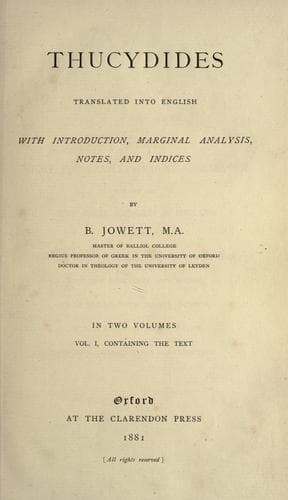
Greece -- History -- Peloponnesian War, 431-404 B.C.
When the Corinthian preparations were completed, they took three days’
provisions and put out from Chimerium by night, ready for action.
Sailing with the dawn, they sighted the Corcyraean fleet out at sea and
coming towards them. When they perceived each other, both sides formed
in order of battle. On the Corcyraean right wing lay the Athenian
ships, the rest of the line being occupied by their own vessels formed
in three squadrons, each of which was commanded by one of the three
admirals. Such was the Corcyraean formation. The Corinthian was as
follows: on the right wing lay the Megarian and Ambraciot ships, in the
centre the rest of the allies in order. But the left was composed of
the best sailers in the Corinthian navy, to encounter the Athenians and
the right wing of the Corcyraeans. As soon as the signals were raised
on either side, they joined battle. Both sides had a large number of
heavy infantry on their decks, and a large number of archers and
darters, the old imperfect armament still prevailing. The sea-fight was
an obstinate one, though not remarkable for its science; indeed it was
more like a battle by land. Whenever they charged each other, the
multitude and crush of the vessels made it by no means easy to get
loose; besides, their hopes of victory lay principally in the heavy
infantry on the decks, who stood and fought in order, the ships
remaining stationary. The manoeuvre of breaking the line was not tried;
in short, strength and pluck had more share in the fight than science.
Everywhere tumult reigned, the battle being one scene of confusion;
meanwhile the Athenian ships, by coming up to the Corcyraeans whenever
they were pressed, served to alarm the enemy, though their commanders
could not join in the battle from fear of their instructions. The right
wing of the Corinthians suffered most. The Corcyraeans routed it, and
chased them in disorder to the continent with twenty ships, sailed up
to their camp, and burnt the tents which they found empty, and
plundered the stuff. So in this quarter the Corinthians and their
allies were defeated, and the Corcyraeans were victorious. But where
the Corinthians themselves were, on the left, they gained a decided
success; the scanty forces of the Corcyraeans being further weakened by
the want of the twenty ships absent on the pursuit. Seeing the
Corcyraeans hard pressed, the Athenians began at length to assist them
more unequivocally. At first, it is true, they refrained from charging
any ships; but when the rout was becoming patent, and the Corinthians
were pressing on, the time at last came when every one set to, and all
distinction was laid aside, and it came to this point, that the
Corinthians and Athenians raised their hands against each other.
Public-domain text, read in full here on John Shaqi.
Reviews
Reviews
No reviews yet
Be the first to share your thoughts on this work.
Join the Discussion
Join the discussion
Sign in to leave a comment or review.
Sign InorCreate an account