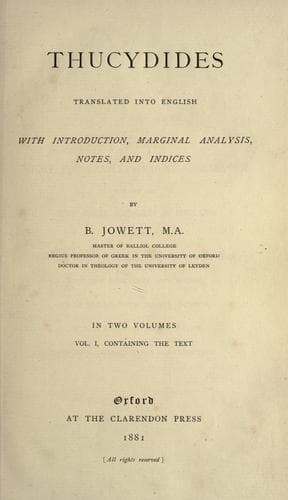
Greece -- History -- Peloponnesian War, 431-404 B.C.
After the rout, the Corinthians, instead of employing themselves in
lashing fast and hauling after them the hulls of the vessels which they
had disabled, turned their attention to the men, whom they butchered as
they sailed through, not caring so much to make prisoners. Some even of
their own friends were slain by them, by mistake, in their ignorance of
the defeat of the right wing For the number of the ships on both sides,
and the distance to which they covered the sea, made it difficult,
after they had once joined, to distinguish between the conquering and
the conquered; this battle proving far greater than any before it, any
at least between Hellenes, for the number of vessels engaged. After the
Corinthians had chased the Corcyraeans to the land, they turned to the
wrecks and their dead, most of whom they succeeded in getting hold of
and conveying to Sybota, the rendezvous of the land forces furnished by
their barbarian allies. Sybota, it must be known, is a desert harbour
of Thesprotis. This task over, they mustered anew, and sailed against
the Corcyraeans, who on their part advanced to meet them with all their
ships that were fit for service and remaining to them, accompanied by
the Athenian vessels, fearing that they might attempt a landing in
their territory. It was by this time getting late, and the paean had
been sung for the attack, when the Corinthians suddenly began to back
water. They had observed twenty Athenian ships sailing up, which had
been sent out afterwards to reinforce the ten vessels by the Athenians,
who feared, as it turned out justly, the defeat of the Corcyraeans and
the inability of their handful of ships to protect them. These ships
were thus seen by the Corinthians first. They suspected that they were
from Athens, and that those which they saw were not all, but that there
were more behind; they accordingly began to retire. The Corcyraeans
meanwhile had not sighted them, as they were advancing from a point
which they could not so well see, and were wondering why the
Corinthians were backing water, when some caught sight of them, and
cried out that there were ships in sight ahead. Upon this they also
retired; for it was now getting dark, and the retreat of the
Corinthians had suspended hostilities. Thus they parted from each
other, and the battle ceased with night. The Corcyraeans were in their
camp at Leukimme, when these twenty ships from Athens, under the
command of Glaucon, the son of Leagrus, and Andocides, son of Leogoras,
bore on through the corpses and the wrecks, and sailed up to the camp,
not long after they were sighted. It was now night, and the Corcyraeans
feared that they might be hostile vessels; but they soon knew them, and
the ships came to anchor.
Public-domain text, read in full here on John Shaqi.
Reviews
Reviews
No reviews yet
Be the first to share your thoughts on this work.
Join the Discussion
Join the discussion
Sign in to leave a comment or review.
Sign InorCreate an account