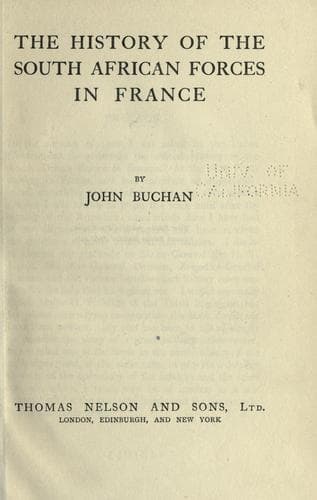
The history of the South African forces in FranceBuchan, John
History
The history of the South African forces in France
Buchan, John
South Africa. Army; World War, 1914-1918 -- Campaigns -- France; World War, 1914-1918 -- Regimental histories -- South Africa
In the beginning of March General Lukin relinquished the command of
the 9th Division to Major-General Tudor, who formerly commanded the
divisional artillery, and returned home on leave. While at home he was
compelled because of the grave illness of his wife to accept the offer
of a tour of duty in England. He had had more than two years of the most
arduous service, first as brigadier and then as divisional general,
and he left to the profound regret of all his colleagues.[25] It was a
departure that could not be without its element of sadness, especially
for the South Africans, for it meant a break in that continuity of
tradition which they had hitherto preserved. They had begun with Lukin,
and till March 1918 they had been directly or indirectly under Lukin.
These changes were, as it were, symbolical of the change which was coming
over the aspect of the war. The former things were passing away; the
long months of almost static trench warfare were about to give place to
a stormy season, when all maps had to be redrawn and every conception of
war revised. It was the eve of the ultimate phase which at long last was
to determine the issue of the campaign.
[Sidenote: _Feb. 17._]
But before these changes came about one great episode in the past record
of the Brigade was commemorated. On the 17th February all its regiments,
including the vanishing 3rd, took part in a memorial service at Delville
Wood. On the south side of the place towards Longueval a tall wooden
cross had been erected, bearing the inscription: “In Memory of the
Officers and Men of the 1st South African Brigade who fell in Action
in July 1916 in the Battle of the Somme.” Before this cross, among the
shattered tree-stumps, the drumhead service was held, and around in a
square stood details of the four battalions. First came a lament on the
pipes, composed by Pipe-Major Grieve of the 4th Regiment. The service
was conducted by the chaplains of the English, Presbyterian, and Dutch
Churches, and the hymns included the beautiful Dutch version of the
Hundredth Psalm. Sir Douglas Haig wrote to General Lukin:—
“I send you these few lines to greet you and all South Africans
who meet together on Sunday next in honour of those brave men
who, at the call of justice and humanity, came from a distant
continent to fight and die for the principles they held sacred.
The story of the great struggle of July 1916 for the ridge
on which Delville Wood stands, when South Africa played so
conspicuous a part, will live for all time in the history of
our Empire—a perpetual witness to the strength of those common
ideals which bind together all British people. The task of
those who fell in Delville Wood and by their gallant death made
desolation glorious, has not yet been completed; but I feel
confident that those who remain will see to it that their blood
shall not have been shed in vain.”
Public-domain text, read in full here on John Shaqi.
Reviews
Reviews
No reviews yet
Be the first to share your thoughts on this work.
Elsewhere in the archive
Join the Discussion
Join the discussion
Sign in to leave a comment or review.
Sign InorCreate an account