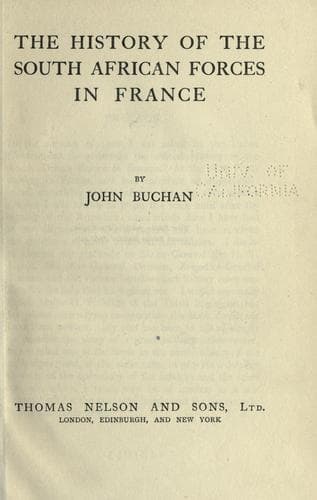
The history of the South African forces in FranceBuchan, John
History
The history of the South African forces in France
Buchan, John
South Africa. Army; World War, 1914-1918 -- Campaigns -- France; World War, 1914-1918 -- Regimental histories -- South Africa
It was a clear day of frost and bright sunshine, and in the pause of the
hymns, like the sound of breakers heard afar off on a coast, came the
drone of airplanes overhead, and the echo of the now distant guns. That
ceremony was something more than a commemoration of a great thing in the
past. It was a sacrament taken in preparation for a still greater test of
manhood now impending. For before the next month had closed, the enemy
flood had once again poured over the wastes of Delville, and the flower
of the South Africans had fallen in a new Thermopylæ.
* * * * *
[Sidenote: _March 12._]
Early in March the Brigade moved up to the front area, and on the night
of the 12th began to take over from the 116th Brigade of the 39th
Division the sector east of Heudicourt. Ever since the close of 1917 the
Allied Command in the West had been conscious that the situation had
altered. The Germans were able now to resume the offensive at their will,
and the next phase of the campaign must see the Allies on their defence.
Haig and Pétain were aware that large reinforcements could be brought
from the East, which would give Ludendorff a numerical superiority until
such time as the Americans arrived to redress the balance. Nevertheless,
the general temper of the armies of France and Britain was one of
confidence. At the worst they believed that they would have to face a
small preponderance in numbers; but they had faced greater odds at First
Ypres and Verdun, and had held their ground. Let the enemy attack and
break his head against their iron barriers. He would only be the weaker
when the time came for their final advance.
But certain wiser heads among both soldiers and civilians were uneasy.
They knew that the German Staff would make a desperate effort to secure
a decision while they still held their opponents at a disadvantage. The
German defence had been conducted in a long-prepared fortified zone;
the battles of 1917 had given us a new line, in parts only a month or
two old. How, it was asked, would we fare against a resolute assault?
Worst of all, we were deplorably short of men. Haig had not received
during 1917 the minimum levies he had asked for, and had been compelled
to put into the line of battle men imperfectly trained, and to strain
good divisions to breaking point. There were other drawbacks which bore
specially hard upon the British. Up to January 1918 their right wing
had been Sir Julian Byng’s Third Army. Before the middle of that month
the Third Army was moved a little farther north, and the place on its
right taken by Sir Hubert Gough’s Fifth Army from the Ypres area, which
replaced the French in front of St. Quentin. About the 20th the Fifth
Army extended its right as far south as Barisis, across the Oise, thus
making itself responsible for a line of 72,000 yards.
Public-domain text, read in full here on John Shaqi.
Reviews
Reviews
No reviews yet
Be the first to share your thoughts on this work.
Elsewhere in the archive
Join the Discussion
Join the discussion
Sign in to leave a comment or review.
Sign InorCreate an account