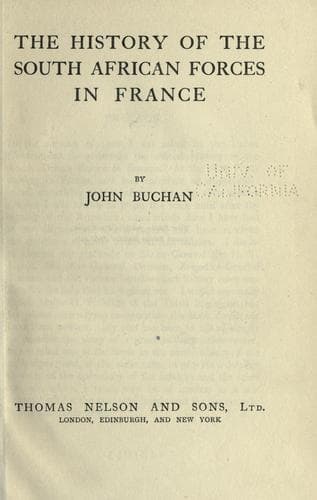
The history of the South African forces in FranceBuchan, John
History
The history of the South African forces in France
Buchan, John
South Africa. Army; World War, 1914-1918 -- Campaigns -- France; World War, 1914-1918 -- Regimental histories -- South Africa
By the 6th of April the German thrust towards Amiens had failed, and for
the moment the gate of the Somme was closed. Brought to a standstill,
Ludendorff cast about for a diversion, for he could not permit the battle
to decline into a stalemate, and so lose the initiative. His main purpose
was the same, but he sought to achieve it by a new method. He would
attack the British elsewhere on some part of the front where they were
notoriously weak, and compel Foch to use up his reserves in its defence.
Then, when the Allied “mass of manœuvre” had shrunk, he would strike
again at the weakened door of Amiens. On Ludendorff’s plan the operation
was to be a strictly subsidiary one, designed to prepare the way for the
accomplishment of his main task farther south. He proposed to allot only
nine divisions for the initial stroke, and to choose a battle-ground
where even a weak force might obtain surprising results.
That battle-ground was the area on both sides of the Lys between the La
Bassée Canal and the Wytschaete Ridge. The German Staff were aware that
it had already been thinned to supply ten divisions for the contest in
the south, and that at the moment it was weakly held, mainly by troops
exhausted in the Somme battle. Haig, as we know from his dispatch, had
drawn especially upon this section, since a retreat there would not
imperil the whole front so gravely as would the loss of ground between
La Bassée and Arras. Nevertheless, it was a very real danger-point.
The enemy had the great city of Lille to screen his assembly. Certain
key-points of communications, like Béthune and Hazebrouck, lay at no
great distance behind the British front. The British communications
were poor, and the German were all but perfect. Any advance threatened
the Channel Ports, and might be expected to cause acute nervousness in
the mind of British Headquarters. Reinforcements would be demanded from
Foch, and the place was far enough from the Amiens battle-ground to put
a heavy strain upon the Allied power of reinforcement. Ludendorff’s aim
was by a sharp, short thrust to confuse the Allied plans and absorb
their reserves. If he could break through at once between La Bassée
and Armentières and capture Béthune, he could swing north-westward and
take Hazebrouck and the hills beyond Bailleul, and so compel a general
retirement west of Dunkirk and the floods of the river Aa. But to succeed
he must have a broad enough front. He must take Béthune at once and the
Messines Ridge soon after, for, if the British pillars of the gate at
Givenchy and Messines should stand, his advance would be squeezed into
narrows where even a weak and tired force might hold it.
[Sidenote: _April 8-9._]
Public-domain text, read in full here on John Shaqi.
Reviews
Reviews
No reviews yet
Be the first to share your thoughts on this work.
Elsewhere in the archive
Join the Discussion
Join the discussion
Sign in to leave a comment or review.
Sign InorCreate an account