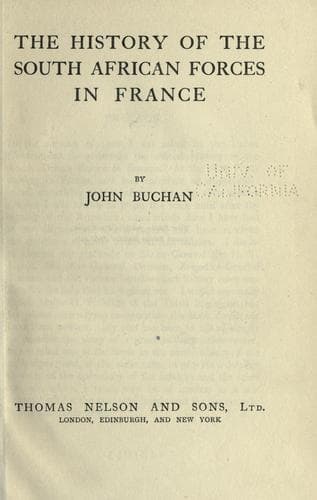
The history of the South African forces in FranceBuchan, John
History
The history of the South African forces in France
Buchan, John
South Africa. Army; World War, 1914-1918 -- Campaigns -- France; World War, 1914-1918 -- Regimental histories -- South Africa
On the 8th the South African Brigade moved to hutments along the road
between La Clytte and the little hill of Scherpenberg. On the morning
of Tuesday, 9th April, Ludendorff struck between the Lys and La Bassée
with von Quast’s VI. Army. He broke that part of the line held by the
Portuguese, and in the afternoon had swept over the Lys on a broad front.
But at one vital point he failed. The 55th (West Lancashire) Division
still held the gatepost at Givenchy, and throughout the whole battle that
key position was never yielded by British troops.
[Sidenote: _April 10._]
That night General Tudor instructed Tanner that the South Africans would
be placed at the disposal of the 19th Division, which, along with the
25th and 9th Divisions, was holding the Messines Ridge and the line
just north of the Lys. The corps was the IX., under Lieutenant-General
Sir A. Hamilton Gordon. Next morning, 10th April, at 5.30 a.m., the IV.
German Army, under our old antagonist at Ypres, Sixt von Armin, attacked
from Frelinghien to as far north as Hill 60. Under cover of the fog the
enemy filtered into our positions from Ploegsteert Wood to Messines
along the valleys of the Warnave and Douve streams. By noon he had
taken Ploegsteert village and the south-east part of the wood, and had
got Messines, while farther north he had driven in our line as far as
Hollebeke, and was close on the Wytschaete crest. Ludendorff was striking
hard against the northern pillar of the gate.
At eight that morning the Brigade was ordered to move to a position of
assembly just south of the village of Neuve Eglise, where they formed
part of the reserve of the IX. Corps. During the morning the march was
accomplished, and for the first time the South Africans saw the impact
of war upon a land yet undevastated. Tanner wrote in his diary: “The
sights in that march from La Clytte are never likely to be forgotten by
those who witnessed them. With the falling back of our line that morning
the shelling of the back areas had greatly increased, both in density
and length of range. As a result, a large belt of country previously
unmolested became subjected to a terrifying storm of long-range
projectiles, and the inhabitants, who up to then had been conducting
peacefully their farming operations, were compelled to flee for shelter
beyond the reach of the enemy guns. As we approached Neuve Eglise the
road from Scherpenberg onward presented a constant stream of fugitives,
old men, women, and children, laden with what household goods they could
remove in carts, wheelbarrows, and perambulators. The most pitiable
sights were those of infirm old people being removed in barrows, pushed
or pulled by women and children.” That was a spectacle which British
troops had already seen east of Amiens, and it was not likely to weaken
their determination in the coming battle.
Public-domain text, read in full here on John Shaqi.
Reviews
Reviews
No reviews yet
Be the first to share your thoughts on this work.
Elsewhere in the archive
Join the Discussion
Join the discussion
Sign in to leave a comment or review.
Sign InorCreate an account