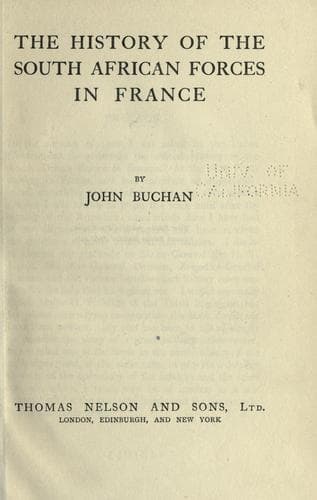
The history of the South African forces in FranceBuchan, John
History
The history of the South African forces in France
Buchan, John
South Africa. Army; World War, 1914-1918 -- Campaigns -- France; World War, 1914-1918 -- Regimental histories -- South Africa
The name of the South African Brigade was still to be retained, and the
unit was to include, in addition to the Composite Battalion, the 9th
Scottish Rifles (formerly in the 27th Brigade) and the 2nd Royal Scots
Fusiliers, that famous battalion which at Ramillies had, along with the
Buffs, led the decisive movement, and which at First Ypres had been all
but annihilated. General Tanner was to be the Brigadier. To reconstruct
a new brigade and a new battalion takes time, and while the work was in
process the unfinished product had to be flung into the fight, for the
Battle of the Lys was not over. Ludendorff had dipped too deeply in the
north to withdraw easily. He had incurred great losses without gaining
any real strategical objective, and he could not bring himself to write
off these losses without another effort to pluck the fruit which was
so near his grasp. If he could seize Kemmel Hill, he would broaden his
comfortless salient and win direct observation over the northern plain.
In front of Kemmel was the junction of the British and French lines,
which he regarded as the weakest spot in our front. Accordingly on
Thursday, the 25th April, he struck again for Kemmel.
[Sidenote: _April 25._]
In the early hours of that day a heavy enemy bombardment presaged the
coming attack. At 3.35 a.m. the South African Battalion, which had been
taken over on the 24th by Lieutenant-Colonel Bamford, was warned to be
ready to move at fifteen minutes’ notice. At 5 a.m. von Armin attacked
with nine divisions, five of which were fresh. His purpose was to
capture Kemmel by a direct assault on the French, and by a simultaneous
attack on the British right south of Wytschaete to turn their flank and
separate the two forces. At first he seemed about to succeed. By ten that
morning he had worked his way round the lower slopes and taken Kemmel
village and the hill itself, though isolated French troops still held
out in both places. In the British area the 9th and 49th Divisions were
hotly engaged west of Wytschaete, and before midday the right of the
9th was forced back to Vierstraat. In the afternoon the 21st Division,
farther north, was also attacked, and by the evening the British front
had been compelled to withdraw to positions running from Hill 60 in the
north by Voormezeele and Ridge Wood to the hamlet of La Clytte on the
Poperinghe-Kemmel road, where it linked up with the French.
[Sidenote: _April 26._]
Public-domain text, read in full here on John Shaqi.
Reviews
Reviews
No reviews yet
Be the first to share your thoughts on this work.
Elsewhere in the archive
Join the Discussion
Join the discussion
Sign in to leave a comment or review.
Sign InorCreate an account